Palmistry
Children Lines: Parenthood and Nurturing Energy
Short vertical lines that branch up from the marriage line area, just below the little finger. Classical palmistry read them as a count of children; modern palmistry treats them more broadly — as a map of nurturing energy and significant care relationships.
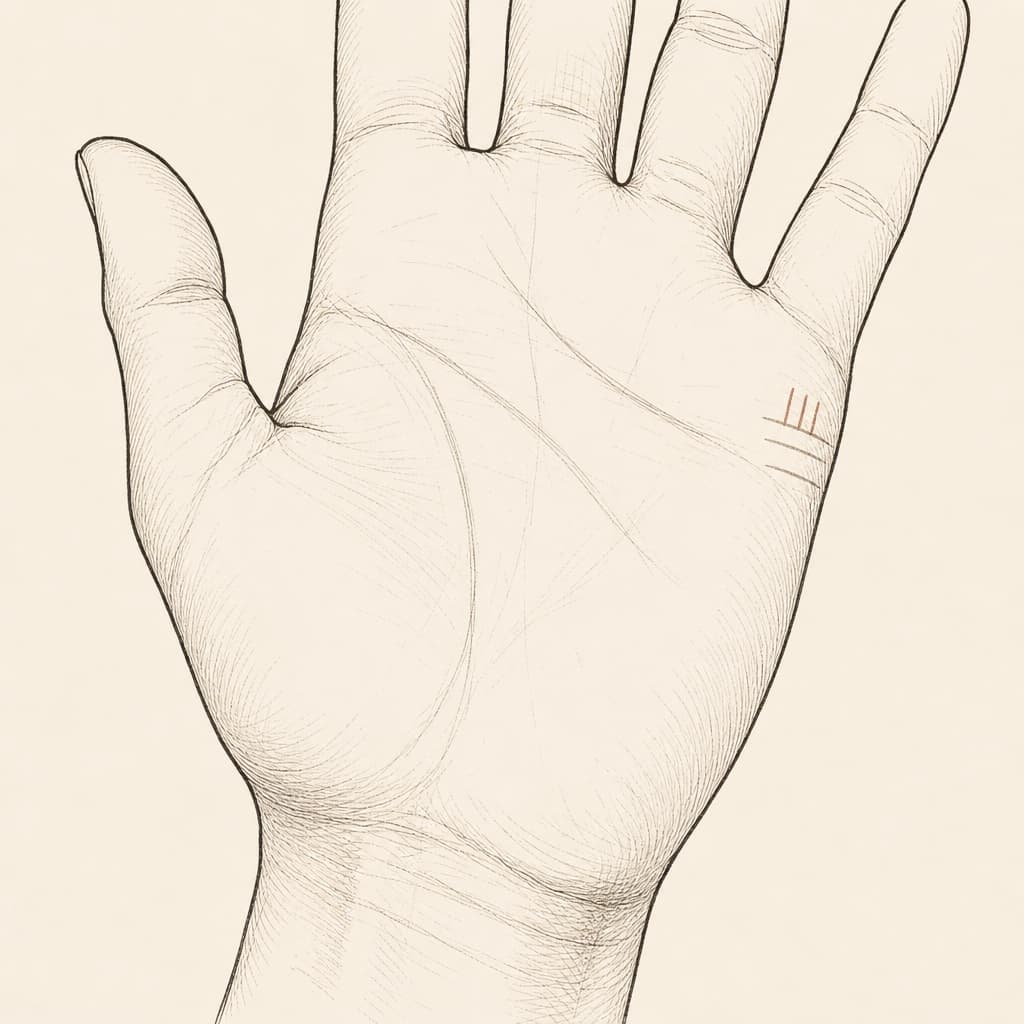
Your children lines are the small vertical marks branching upward from the marriage-line area on the percussion edge of your palm — the tiny zone just below the base of your little finger. They are read for nurturing energy: your orientation toward care, the significance of children in your life, and how parenthood (biological or otherwise) is likely to fit into the shape of your years.
In Indian families these are the lines an aunt or grandmother might have looked at to count "kitne bachche". The cultural weight is real — but the count itself is rougher than the tradition often suggests. Many people with several biological children show only one or two clear lines. Many with strong children lines never have biological children but become deeply central to nephews, nieces, mentees, students, or younger siblings' lives.
What the lines genuinely indicate is the strength of your nurturing energy and the kind of care relationships you tend toward. Whether that translates into birth-children, adopted children, fostered children, or the children of close friends — palmistry doesn't pretend to know.
If you'd like to see what your own children-line area suggests about the care relationships in your life, the app reads it from a palm photo.
Where children lines are and how to find them
Look at the percussion edge of your dominant hand. Find the marriage line area — the small zone of horizontal lines just below the base of the little finger, above the heart line. The small vertical lines branching upward from this area, often very faint, are the children lines.
These lines are usually quite small. You may need a magnifying glass or strong angled light to see them clearly. The depth and length of each line is what palmists weight, not just the count.
What the lines actually indicate
Primarily, the strength of nurturing energy. A person with several clear children lines tends to be wired for care — they instinctively look after others, find meaning in supporting younger people, and become important figures in the lives of children around them, biologically theirs or not. A person with no clear children lines tends to be oriented elsewhere; they can care for children perfectly well but it is not their primary mode of engagement with the world.
Secondarily, the presence and significance of specific children. Each clearly-defined deep line was classically read as one significant child relationship — though the literal count is rarely exact. The lines more often reflect emotional investment in specific children than a headcount.
In Indian family contexts the children-line area often comes under more attention than the lines genuinely warrant — particularly from in-laws and grandparents after a marriage. The line describes an orientation toward care, not a fertility prediction. That distinction is worth holding onto when the question gets asked across a dinner table; the lines are not what people sometimes wish them to be.
How Indian and Western traditions differ
Indian palmistry reads children lines more carefully and more literally than Western palmistry does. Vedic palmistry has detailed conventions: line depth for the strength of the bond, the order of lines from the marriage line outward for birth order, sometimes gendered readings (a convention modern palmists have moved away from). The literal-count tradition is part of what made palmistry a household practice in India — it answered a question families repeatedly asked.
The literal-count tradition also reflects a social context where childbearing was, and in many families still is, closely watched. In joint-family or multi-generational households the children lines are sometimes consulted alongside the marriage line, particularly for younger women, in a way that conflates social expectation with biological forecasting. Worth being honest about: the lines are not designed for that question and shouldn't be used to answer it.
Western palmistry, particularly post-Cheiro, treats children lines as one of many minor lines and reads them more loosely. Western palmists tend to focus on the nurturing-energy reading rather than the literal count.
Both traditions agree on the limit: children lines do not predict the children of a specific marriage in detail, and they should never be used as a fertility prediction. People who have struggled with fertility have understandably looked to their palms for reassurance; palmists who know the tradition well are careful not to overstate what these lines can tell.
Children line variations
Several clear children lines
Multiple deeply-defined vertical lines branching from the marriage line area are read as a person whose life will include significant care relationships with children. This may take the form of biological parenthood with several children, or it may take the form of one or two biological children plus deep involvement with nieces, nephews, mentees, students, or other young people.
One strong children line
A single deeply-defined line is read as one particularly significant child relationship — often, in classical readings, the child the person has the deepest emotional bond with. May or may not be a biological child.
Faint children lines
Faint vertical marks in the area are read as smaller-significance care relationships — children the person is connected to but not central to, godchildren, students, the children of close friends. Classical palmistry sometimes also read faint lines as pregnancies that did not result in births; modern palmists treat this reading with care, since it can cause unnecessary anxiety.
No visible children lines
A marriage-line area with no visible children lines is common and is not predictive. Some people without children lines have biological children; some people with strong children lines never have biological children. The absence indicates that the person's life is not centrally organised around the care of children, which is a description of the person rather than a prediction of childlessness.
Forked children line
A children line that branches into a small fork at its top is read in classical palmistry as twins. Modern palmists treat this as suggestive rather than reliable — the fork can also indicate a particularly complex care relationship with a single child, or a child whose life took two distinct directions.
Children line crossed by a horizontal mark
A horizontal line crossing a children line is read as a difficult period in the relationship with that particular child — illness, conflict, a phase of distance. The depth of the crossing line indicates the severity.
Common questions
Does the number of children lines on my palm predict how many children I will have?
Not reliably. The classical reading was that each clear vertical line indicated one child, but the literal count is rarely accurate. Many people with several biological children show only one or two clear lines; many people with strong children lines never have biological children but become deeply involved in the care of nieces, nephews, mentees, or students. The lines more reliably indicate the strength of your nurturing energy and the significance of care relationships in your life than they predict a specific child count.
In Indian families children lines often get checked for fertility. Is that reliable?
No, and this is one of the places where the older folk tradition can cause real harm. Children lines indicate orientation toward care — they do not reliably predict whether you will have biological children, when, or how many. If fertility is a concern, see a doctor; palmistry has nothing useful to add. The tradition's attention to this region of the palm reflects social expectation more than biological forecasting, and the older folk readings get this distinction wrong in a way that has caused unnecessary distress.
I want children but I don't see any children lines. Should I be worried?
No. Children lines are small and often very faint — they can be difficult to see without strong light and a magnifying glass. More importantly, the absence of clear children lines is not a fertility prediction. People without visible children lines have biological children; people with strong children lines do not always have biological children. If having children is something you want, palmistry is not the right tool to predict whether you will — it will tell you about your nurturing temperament, not your fertility.
Can children lines indicate adopted or step-children?
Yes. Modern palmistry reads children lines as significant care relationships, not specifically biological ties. Adopted children, step-children, fostered children, and even particularly close mentor-mentee relationships can register on the palm in this area. The lines record emotional involvement and parental investment, not genetic relationship.
What does it mean if I have a forked children line?
Classical palmistry read a forked children line as twins. Modern palmists are more cautious — the fork can also indicate a particularly complex relationship with a single child, or a child whose own life took two distinct directions that the parent was deeply involved in. The folk reading of "twins" is suggestive but not reliable.
Related reading
- Marriage Line— In Indian palmistry: long-term partnership, emotional unions, and significant relationships.
- Heart Line— How you love, how you trust, and what your relational style says about you.
- How to Read Your Palm— The complete beginner's guide — which hand to read, which lines matter, and the order to read them in.