Palmistry
How to Read Your Own Palm
A working guide for beginners. Which hand to read, how to find each line, what to read first, and how to put the parts together into a coherent picture.
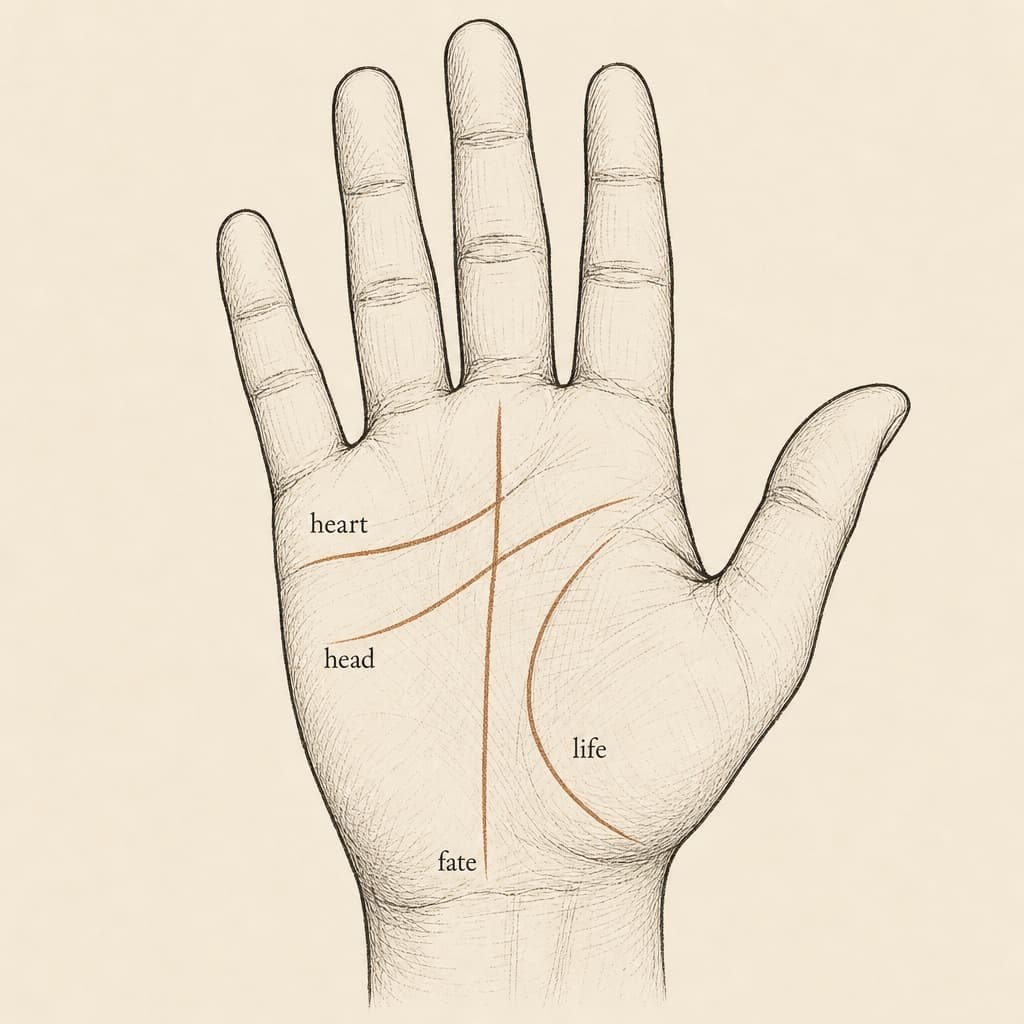
Palm reading — hast rekha shastra in the Indian tradition — looks intimidating from the outside, but the basic structure is simple. There are four major lines, three or four minor ones, and seven raised mounts. Once you know which is which and roughly what each is for, you can give a useful reading of your own palm — or someone else's — in about an hour.
What follows is a working guide. Read it once front to back. Then open your dominant hand and follow it again, this time pausing at each line to look at your own. After that the basics on most palms will be readable to you, including yours.
A short note on what palm reading is. It isn't predictive science — the lines on your hand don't foretell what will happen the way a weather report foretells rain. It is a structured vocabulary for thinking about who you are and how you tend to operate. Useful when its categories help you see something true; less useful when forced into prediction.
Or, if you'd like to see what a careful AI reading of your own palm looks like before you start practising on others, the app does it from a single photo.
Step 1: Choose which hand to read
In modern practice, palmists read both hands — the non-dominant hand for what you were born with (your potential, your inheritance, your starting conditions) and the dominant hand for what you have done with it (your developed self, your current trajectory). The differences between the two hands are themselves meaningful: a person whose two hands look very different has changed substantially from who they started out being.
If you are only going to read one hand, read your dominant hand — the one you write with. It tells you who you are now, which is usually what people want to know.
There is more on this question, including the Indian tradition's right-hand-for-men / left-hand-for-women convention, on the dedicated page about left vs right hand in palmistry.
Step 2: Find the four major lines
Open your hand, palm up, fingers slightly curled. You should see three to four major lines crossing your palm. They are:
The heart line — the upper of the two long horizontal lines, running from below the little finger toward the index finger. This is the line palmistry reads for love and emotional life. The end point matters most: a line ending under the index finger reads as romantic-idealist; ending between the index and middle reads as balanced; ending under the middle finger reads as self-reliant.
The head line — the lower of the two long horizontal lines, running roughly parallel to and below the heart line. It begins between the thumb and index finger (often joined to the start of the life line) and crosses the palm. The head line is read for thinking style. A straight line indicates analytical thinking; a downward-curving line indicates imaginative thinking; a sharply diving line indicates a deeply intuitive or creative mind.
The life line — the curved line that wraps around the base of the thumb. It begins between the thumb and index finger and arcs downward toward the wrist, enclosing the fleshy mound at the thumb's base. The life line is read for vitality and how you handle change — not, despite the persistent myth, for how long you will live. A short life line does not predict an early death; it indicates focused, intense vitality concentrated in particular phases of life.
The fate line — the vertical line running up the centre of the palm, from somewhere near the wrist toward the middle finger. The fate line is the most variable of the four; many palms show only a short segment of it, and many palms show no fate line at all. A missing fate line is not a problem — it indicates a self-directed person whose life shape is determined by their own choices rather than by external structures.
Step 3: Read the lines in this order
Most beginners try to read every line at once and end up confused. The classical order is to read in this sequence: life line first, then head line, then heart line, then fate line, then minor lines.
Reading the life line first establishes the person's baseline vitality and physical orientation. Reading the head line second tells you how they think. Reading the heart line third tells you how they feel. Reading the fate line fourth tells you about their direction and external circumstances. By the time you get to the minor lines (sun, marriage, money, travel, children, health), you already have a strong picture of the person and the minor lines add specifics rather than fundamentals.
For each line, look at: where it starts, where it ends, how deep it is, how long it is, and whether it is clean or has breaks/chains/forks. These five features cover almost everything you need for a basic reading.
Step 4: Notice the relationships between lines
A reading is not just four separate lines — it is the picture they make together. A few of the most informative relationships:
Heart line vs head line: which is deeper, which is longer, which dominates? A deeper heart line indicates a person who leads with feeling. A deeper head line indicates a person who leads with thought. Roughly equal lines indicate a balanced personality (and are less common than people assume).
Head line and life line at the start: are they joined, separate, or overlapping? Joined indicates strong family influence on early thinking; separate indicates early independence; the head line beginning inside the life line indicates a particularly cautious early character.
Fate line's starting point: at the wrist (early-determined direction), from inside the life line (career shaped by family), from the Mount of Luna (career shaped by the public), or partway up (late-developing direction). Each tells you a different story about how the person's working life took shape.
Step 5: Look at the mounts
The mounts are the raised areas on the palm — the small fleshy pads under each finger and at certain other positions. They frame how the lines are read. The seven mounts are:
Mount of Venus (under the thumb, inside the life line's arc) — vitality, sensuality, life-force.
Mount of Jupiter (under the index finger) — ambition, leadership, idealism.
Mount of Saturn (under the middle finger) — responsibility, discipline, the serious side of life.
Mount of Apollo (under the ring finger) — creativity, recognition, public-facing brilliance.
Mount of Mercury (under the little finger) — communication, commerce, quickness.
Mount of Mars (two of them — one between the thumb and life line, the other on the percussion edge between the heart line and Mount of Mercury) — courage, resilience, fighting spirit.
Mount of Luna (on the percussion edge, lower portion of the palm) — imagination, intuition, the unconscious.
A mount that is firm and well-developed is read as that quality being strong in the person; a flat or undeveloped mount is read as that quality being less central. The full guide to mounts is on its own page; for a basic reading, just notice which mounts on your palm are most prominent.
Step 6: Read minor lines as needed
Once you have read the major lines and noticed the prominent mounts, you have a basic reading. The minor lines (sun, marriage, money, travel, children, health) add specifics for particular questions. You don't need to read all of them every time — pull in the minor line that's relevant to what you're asking.
For questions about love and partnership: read the heart line + the marriage line area.
For questions about career and direction: read the fate line + the sun line + the head line.
For questions about money: read the Mercury line + the sun line + the fate line.
For questions about travel and migration: read the Mount of Luna + travel lines.
For questions about children and care: read the children lines + the heart line.
For questions about constitution: read the life line + (if present) the health line, and look at the Mount of Venus.
Step 7: Hold the reading lightly
A good palm reading is descriptive, not prescriptive. It says "this is the kind of person you tend to be" — it does not say "this is what will happen to you." When you finish reading a palm (your own or someone else's), the right ending is something like "does this seem right to you?" — because the only test of a reading is whether it gives the person language for something they already half-knew about themselves.
If a reading lands as completely wrong, that is also useful information. Either you misread something on the palm, or the categories palmistry uses don't describe this person well, or the person is more complicated than the simple version of the reading allowed for. Any of those is fine; none of them is a failure.
The main thing is to avoid prediction-style claims (you will marry at twenty-six; you will have three children; you will die at sixty-two). Classical palmistry, read carefully, doesn't actually claim to do this. Folk palmistry sometimes does, and palmists who go that route discredit the tradition.
Common questions
Do I need any tools to read a palm?
Strictly, no — just a palm and good light. A magnifying glass is helpful for the smaller lines (children lines, fine variations on the marriage and Mercury lines). Some palmists use a marker pen to trace lightly along lines on the hand to make them easier to see; others take a photograph of the hand and zoom in. For your own palm, holding it under a desk lamp and tilting it slightly is usually enough.
How long does it take to learn the basics?
About an hour to learn enough to read the major lines on your own palm and give a coherent basic reading. A few days of practice — looking at multiple palms, noticing the variations — to become reasonably reliable. Years to develop the kind of subtle pattern-recognition that makes palmistry feel intuitive rather than checklist-based. The basics are not hard; the depth is.
What if my palm doesn't match any of the standard descriptions?
It will, mostly — the descriptions are general enough that most palms will fit at least roughly. Where your palm doesn't match, that is itself information: the standard description doesn't apply because your particular configuration is unusual or because two patterns are interacting in a way the standard description doesn't cover. Trust what you actually see on the hand over what a description tells you to see.
Can I read someone else's palm without learning everything first?
Yes. Most readings happen in casual settings where you and the other person are looking at their hand together. Walk through the steps above, share what you notice, and ask whether it lands. The risk in reading other people's palms is making prediction-style claims you can't back up; the safe path is sticking to descriptive readings ("you tend to ..." rather than "you will ...").
Related reading
- Heart Line— How you love, how you trust, and what your relational style says about you.
- Head Line— How you think — analytical or intuitive, focused or wide-ranging.
- Life Line— Vitality, energy, and the rhythm of how you move through change — not, contrary to myth, lifespan.
- Fate Line— Career trajectory, sense of direction, and external forces shaping your path.
- Left Hand vs Right Hand— The single most-asked question in palmistry. Different traditions, different answers — here's how to decide.
- Mounts of the Palm— Venus, Jupiter, Saturn, Apollo, Mercury, Mars, Luna — the raised areas that frame how every line is read.