Palmistry
The Marriage Line and What It Says
The short horizontal lines on the percussion edge of the palm, just below the little finger. These are the lines classical palmistry — particularly Indian palmistry — reads for significant unions: marriages, long-term partnerships, and the relationships that shape a life.
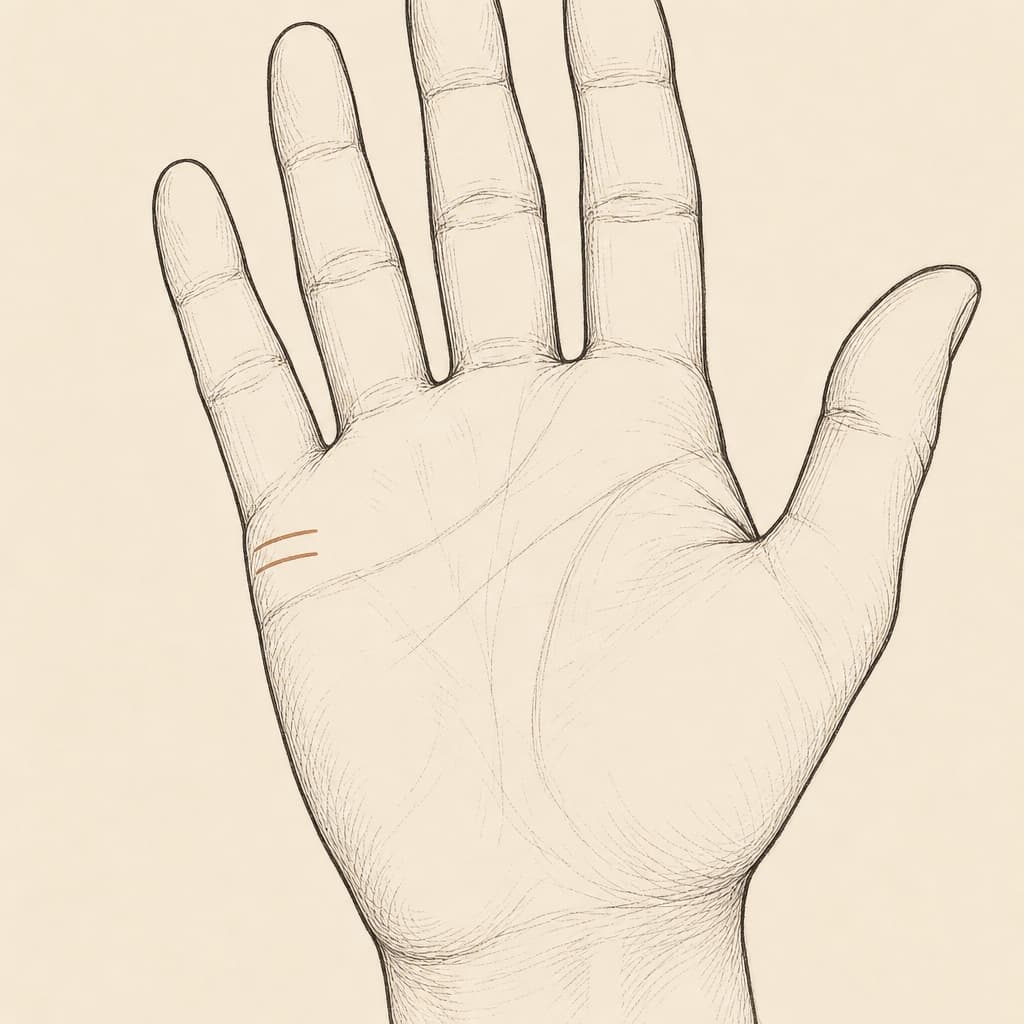
Your marriage lines — vivah rekha in Indian palmistry — are the short horizontal lines on the percussion edge of your palm, just below the base of your little finger. In Indian tradition, where this region of the hand carries more weight than in any other school, they are read for significant long-term partnerships: how many you are likely to have, how each one is likely to unfold, and what role partnership plays in shaping your life.
If your aunt or grandmother ever tilted your palm to count your marriage lines, this is the area she was looking at. The cultural weight of these lines in India — particularly in matchmaking conversations — is real. They cannot tell you who you will marry, or when. They can tell you something genuine about the character and number of your significant unions.
Two practical notes. First, "marriage line" is a loose translation; in modern reading the line covers any significant long-term partnership, not specifically a wedding. A serious unmarried relationship of many years registers the same way. Second, anyone who claims to read the date of your marriage from this line alone is overreading it.
If you'd like to see what your own marriage-line area shows about your significant partnerships, the app reads it from a palm photo and walks you through what it finds.
Where the marriage line is and how to find it
Hold up your dominant hand and look at the percussion edge — the side of the palm opposite the thumb, below the little finger. The area between the base of the little finger and the heart line is called the Mount of Mercury in palmistry. The marriage line sits in that small zone: short horizontal lines running inward from the percussion edge.
Many palms have several short horizontal lines in this area. The classical convention is to read only the deeper, more clearly defined ones as marriage lines. Tiny faint marks and surface lines are usually read as flirtations, attractions, or short-term relationships rather than as significant partnerships.
How many marriage lines = how many partnerships?
This is the question that comes up most often. The classical reading is that the number of clearly-defined marriage lines indicates the number of significant long-term partnerships in a life. Most palms show one or two clear lines; three is uncommon; more than three is rare.
Two caveats matter. First, "significant partnership" includes any union the person experienced as defining — a serious long-term unmarried relationship counts the same as a marriage. Second, the line reads forward as well as backward: a person in their twenties with two clear marriage lines is read as likely to have two significant long-term partnerships in their life, not currently having two.
In practice, palmists tend to read the strongest marriage line for the most significant partnership of the person's life, and treat the others as adjacent or sequential. Where the lines sit relative to each other matters: lines very close together are read as overlapping or sequential relationships; widely spaced lines as significant partnerships separated by long single periods.
In Indian families this question has a specific second context: matchmaking conversations. A relative or family astrologer is sometimes asked to compare prospective partners' palms or charts, with the marriage line weighed alongside the kundli for compatibility. This is a long tradition with its own integrity. Worth knowing, though: compatibility in palmistry is not actually read from one partner's marriage line in isolation — it is read across both palms together, with the heart line, the planetary mounts, and the relationship between the two charts all carrying weight. The marriage line alone is not a compatibility test.
Reading the line itself: depth, length, and direction
After the count, the quality of each line matters more than the count itself.
Depth is read as significance. A deeply etched marriage line indicates a partnership that defines a substantial portion of the person's life — a long, formative relationship. A faint marriage line indicates a partnership that is real but does not become the central organising feature of the person's identity.
Length is read as duration and depth of involvement. A long marriage line — one that travels well into the palm, sometimes reaching the Mount of Apollo (under the ring finger) — is read as a partnership that lasts and that significantly shapes the person's development. A short line is read as a meaningful but more contained partnership: perhaps a relationship that ended, or one that occupied a specific phase of life rather than becoming life-long.
Direction matters. A marriage line that travels straight horizontally is read as a stable, balanced partnership. A line that curves upward at the end is read as an enduringly happy partnership — both Vedic and Western traditions treat this as one of the most positive marriage-line patterns. A line that curves downward at the end is read more cautiously: a partnership that began well but where the trajectory shifted, often associated with relationships that became difficult over time.
How Indian and Western traditions differ
Indian palmistry pays substantially more attention to the marriage line than Western palmistry does. Vedic palmistry has detailed sub-readings: forks at the end (separation), islands (periods of difficulty), branches (children from the union), and the line's relationship to other lines (the heart line crossing it, the fate line ending at it). Marriage prediction has historical and cultural weight in the Indian context that it does not have in the Western tradition.
The cultural weight differs because the social weight of marriage differs. In a society where extended family takes a serious interest in marriages — arranged, semi-arranged, or "love" — the marriage line earns a kind of scrutiny that doesn't map onto Western individualistic relationship-reading. The line gets discussed at engagements, looked at by in-laws, referenced in matchmaking, and remembered when the marriage faces difficulty. For better or worse it is a more public artifact in this culture than in any other.
Western palmistry, particularly post-Cheiro, treats the marriage line as one of many minor lines and weights it less heavily than the heart line for matters of love and partnership. Western palmists tend to read the heart line for relational style and use the marriage line only for specific questions about how many significant unions.
The practical Indian compromise: read the heart line for how you love (your relational style, your emotional patterns), and read the marriage line for how many significant partnerships and what their character is likely to be. Together they give a fuller picture than either alone — and they pull less weight than family conversations sometimes assume.
Marriage line variations
One clear marriage line
A single deeply-defined horizontal line in the marriage line area is the most common pattern. Read as one significant lifelong partnership — though the depth, length, and direction of that one line still tell you a great deal about its character.
Two marriage lines
Two clearly-defined lines, with a visible gap between them, are read as two significant partnerships in a lifetime — typically sequential rather than overlapping. Common in palms of people who divorce and remarry, but also in palms of people whose first long relationship (sometimes from young) ended in their twenties and whose second became their lifetime partnership.
Three or more marriage lines
Three or more clearly-defined lines is uncommon. Read as a person whose life includes several significant long-term partnerships. Modern palmists treat this configuration carefully — it does not indicate "many marriages" in a judgemental sense, but a relational life with multiple distinct chapters.
Curved-up marriage line
A marriage line that bends upward at its end — sometimes reaching toward the base of the little finger — is read as one of the most positive marriage-line patterns: a partnership that grows over time, that sustains, that becomes more rather than less important to both people across the years. Vedic palmistry treats this as the line of an enduring happy union.
Curved-down marriage line
A marriage line that bends downward at its end is read more cautiously. Classical palmistry interprets this as a partnership that loses its trajectory over time — beginning well but becoming difficult, distant, or unhappy. Modern palmists often soften this reading: it may indicate a partnership that requires deliberate work to sustain, rather than one that is fated to fail.
Forked marriage line
A marriage line splitting into two branches at its end is classically read as separation — the partnership ends, by death or divorce. A fork can also indicate a partnership that becomes two parallel lives within the same union, or a relationship that goes through a period of separation and reunion. The fork's sharpness matters: a clean, deep fork reads more like ending; a soft fork reads more like change.
Island on the marriage line
A small oval break in the line — like an island — is read as a difficult period within an otherwise continuous partnership. The line picking up clean after the island is read as a relationship that came through a hard chapter intact.
Marriage line with a small upward branch
A small line branching upward from the marriage line is traditionally read as a child from that union (or, in non-procreative readings, as a project, business, or shared creation born of the partnership). The number of small upward branches is sometimes read as the number of children, though modern palmists treat this as folk-reading rather than reliable interpretation.
Marriage line crossed by a vertical line
A short vertical line crossing the marriage line is read in classical palmistry as obstacles within the partnership — interference, opposition from family, or recurring conflict. The depth of the crossing line indicates the severity. A faint crossing is mild friction; a deep crossing is significant difficulty.
No visible marriage line
Some palms show no clearly-defined marriage line at all. This is read in classical palmistry as a person whose primary identity is not built around partnership — either because they remain single by choice, because their significant relationships are non-romantic (deep friendships, devotional or religious commitment, the parent-child relationship as primary), or simply because the marriage line is too faint to read at the moment. Marriage lines can develop and deepen across a life as significant partnerships emerge.
Common questions
Does the marriage line predict when I will marry?
Not reliably. Classical palmistry has methods for estimating the timing of a marriage based on where the line sits between the heart line and the base of the little finger — lines closer to the heart line indicate earlier partnership, lines closer to the little finger indicate later partnership — but this is a rough indicator at best, and modern palmists treat it cautiously. The marriage line is more reliable for telling you about the character of partnerships you have or will have than about the calendar date of any wedding.
I have multiple lines in the marriage area. Does that mean multiple marriages?
Not necessarily. The classical reading is that the number of clearly-defined marriage lines indicates the number of significant long-term partnerships — which may or may not be marriages. A serious long-term unmarried relationship registers on the palm the same way a marriage does. Many palmists also count only the deepest, clearest lines and treat fainter marks as flirtations or short attractions rather than significant partnerships.
Is the marriage line the same in Indian and Western palmistry?
The location is the same — the percussion edge of the hand below the little finger — but the weight given to the line differs. Indian palmistry treats the marriage line as a major reading feature with detailed sub-interpretations (forks for separation, branches for children, islands for difficult periods). Western palmistry, particularly post-Cheiro, weights the heart line more heavily for matters of love and uses the marriage line only for specific count questions. Both traditions agree on what to look for; they differ on how much to read into it.
My marriage line forks at the end. Does that mean divorce?
A forked marriage line is read in classical palmistry as separation, but modern palmists are more measured. A fork can indicate divorce, but it can also indicate a partnership that becomes two parallel lives within the same union, or a relationship that goes through extended separation and reunion. The sharpness and depth of the fork matter — a clean, deep fork reads more like ending; a soft, shallow fork reads more like change.
Can my marriage line change?
Yes. The marriage line is one of the lines most likely to change visibly across a life. New lines can appear when a significant new partnership begins; existing lines can deepen as partnerships develop; lines can fade or fragment when relationships end. A palm read at twenty-five and again at forty-five often shows a meaningfully different marriage line area, reflecting the relational history that has unfolded in between.
Related reading
- Heart Line— How you love, how you trust, and what your relational style says about you.
- Children Lines— Parenthood, nurturing energy, and the relationships that come from it.
- How to Read Your Palm— The complete beginner's guide — which hand to read, which lines matter, and the order to read them in.
- Left Hand vs Right Hand— The single most-asked question in palmistry. Different traditions, different answers — here's how to decide.