Palmistry
What Your Heart Line Says About You
The upper of the two horizontal lines on your palm. It tracks how you experience love, attachment, and emotional life — and it has the longest tradition of being read of any line on the hand.
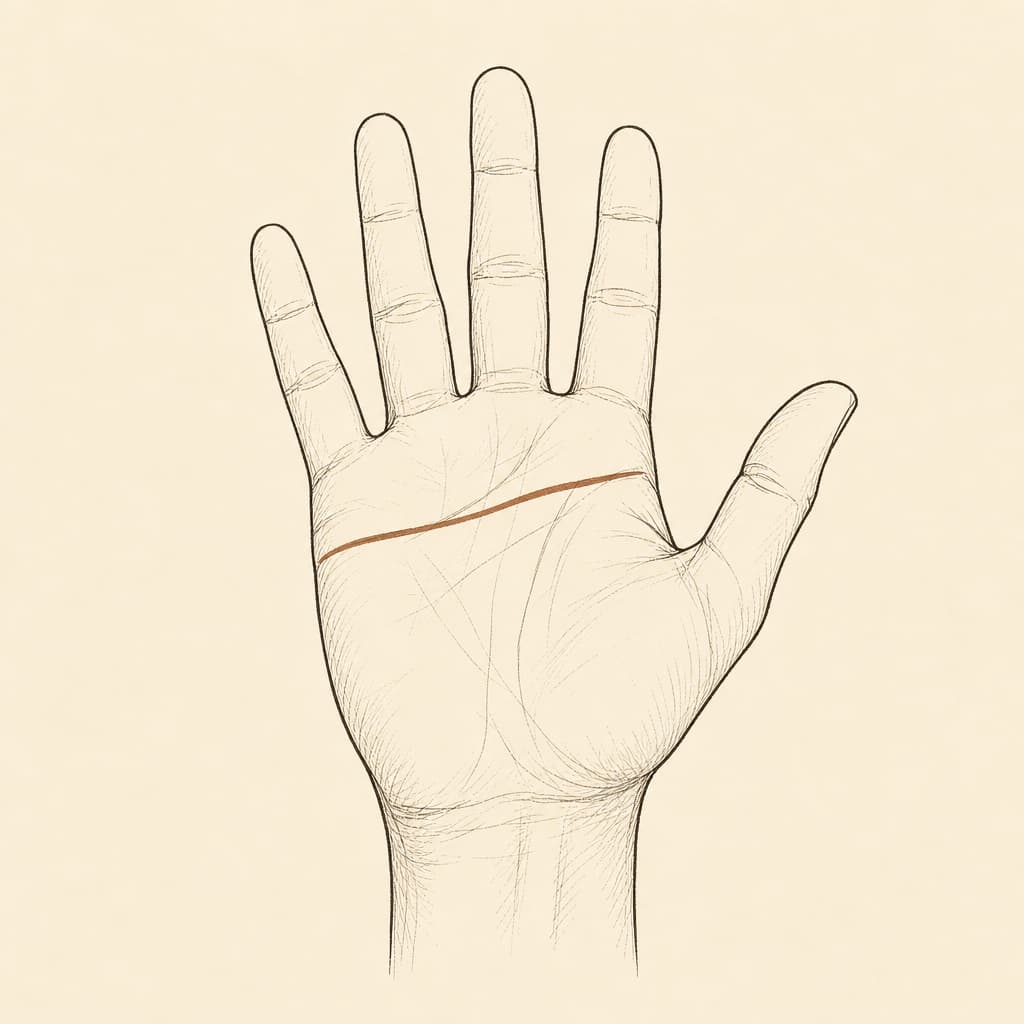
Your heart line — hridaya rekha in Indian palmistry — is the line your palm is read for love. How you trust, how you hold on, how much of yourself you let other people see, and how you behave when an attachment goes wrong. It runs across the upper part of your palm from below the little finger toward the index, and of all the lines in palmistry it is the one most people want to know about first.
The classical traditions agree on what the line is for and disagree mostly on emphasis. Vedic palmistry reads the heart line for the quality of attachments — loyalty, devotion, the capacity to love deeply. The Western tradition (the one most of modern English-language palmistry inherited from the nineteenth-century palmist Cheiro) reads it more for emotional temperament and partnership compatibility. Both are looking at the same line; they ask it slightly different questions.
It is not, despite the name, a marriage predictor. That is what the marriage lines are for — the small horizontal marks on the percussion edge just below the little finger. The heart line is broader: it is about how you love, not who you marry.
If you'd like to see what your own heart line says about how you love — without holding your palm up to the light squinting at lines — the app reads it from a photo and walks you through what it finds.
Where the heart line is
Look at the front of your dominant hand with your fingers held loosely closed. You should see two long horizontal lines crossing the palm. The upper one — closer to the base of the fingers — is the heart line. The lower one is the head line. (If you only see one horizontal line, you may have what is called a simian line, where the heart and head lines have fused. That is its own variant, covered below.)
The heart line typically starts on the percussion edge of the hand, between the base of the little finger and the wrist, and travels across the palm. Where it ends is one of the most diagnostic features in heart-line reading. The three classical end points are: under the index finger (Mount of Jupiter), between the index and middle fingers, or under the middle finger (Mount of Saturn).
The three classical end points
The end of the heart line is the part most palmists weight most heavily. The reasoning: where a line travels gives you general information; where it stops tells you what part of the personality the line ultimately serves.
A heart line that ends under the index finger — touching or curving up to the Mount of Jupiter — is read in both traditions as the romantic-idealist line. It belongs to people who fall in love with people, with ideas, with causes. They want their relationships to stand for something. They are often described as "in love with love." The shadow side: idealism that does not survive contact with the ordinary, repeated disappointments when partners turn out to be specific people rather than embodiments of a feeling.
A heart line that ends between the index and middle fingers is the most common variant. It is read as balanced — a person who loves practically. They take their feelings seriously but also take logistics seriously. Less prone to the sweep of romantic idealism, less prone to the cool detachment of the next variant. Most palmists treat this as the long-term-partnership line — the one most associated with stable, sustained relationships.
A heart line that ends under the middle finger (Mount of Saturn) is read as the self-reliant line. People with this ending are often described as private about their inner life, slow to trust, and capable of significant emotional independence. Vedic palmistry sometimes reads this as a person whose relationships will be tested by responsibility — work, family obligation, caretaking — rather than by romantic instability.
Reading the line itself: depth, length, clarity
After the end point, palmists look at the quality of the line. Three things matter: how deep it is, how long it is, and how clean (unbroken, uninterrupted) it is.
Depth is read as intensity. A deeply etched heart line — one you can feel as a groove if you run your finger across it — is associated with strong emotional experience, the kind of person whose feelings register loudly. A faint or shallow line is not the absence of feeling; it is more often associated with a person whose emotional life is internal, less expressed outwardly, more cerebral than reactive.
Length is read as range. A long heart line that reaches all the way across the palm is associated with a wide emotional vocabulary — many friendships, many connections, the capacity to care about a lot of people. A short line is associated with focus — fewer attachments, but those few are taken very seriously.
Clarity is read as steadiness. A clean, continuous line is associated with consistency — a person whose emotional life follows a recognisable pattern. Breaks, chains (a sequence of small linked loops), and islands (small oval-shaped breaks) are all read as periods of disturbance — a relationship loss, a betrayal, a depressive period, a major shift in how the person relates. The location of the break on the line is read by some palmists as a rough indicator of when the disturbance happened or will happen, with the start of the line representing earlier life and the end representing later life.
Heart line variations
These are the most-asked-about heart line patterns. Many palms show more than one — a long line that also has a fork at the end, for instance — and each adds a layer to the reading rather than overriding the others.
Long heart line
A heart line that travels all the way across the palm and curves up toward the index finger is the long-line variant. Read as: emotionally generous, wide social network, often the friend others go to with their problems. Capable of caring about many people at once. The shadow: can struggle with boundaries, may give more than they get back without noticing for a long time.
Short heart line
A heart line that stops well before reaching the centre of the palm — typically ending under or just past the little finger — is the short-line variant. This is not coldness. It is concentration. Read as: a small number of intense attachments, high loyalty within the chosen circle, strong privacy about emotional life. Outsiders often read short-heart-line people as harder to know than they are.
Straight heart line
A heart line that travels horizontally with little or no upward curve is the straight variant. Read in both traditions as cooler, more analytical, more self-protective. The straight-line person tends to think about emotion before expressing it. Often pairs well with a strong head line: they make their decisions deliberately, including emotional ones. The shadow: can read as withholding to people who expect feeling to be expressive.
Curved heart line
A heart line that sweeps upward as it crosses the palm, ending high near the base of the fingers, is the curved variant. This is the warmly expressive line. Read as: feels things openly, says what they feel, is led by the heart in choices both small and consequential. The shadow: vulnerable to being talked out of their own clarity by someone with a stronger logical line.
Forked heart line
A heart line that splits into two or three branches at its end is one of the most common variants and one of the most positive readings in classical palmistry. The fork is read as a combination — the person draws on more than one mode of relating. A two-branch fork ending under the index and between the index and middle is read as the balance of romantic idealism with practical love. A three-branch fork (sometimes called a trident) is rare and read as a particularly fortunate line: emotional intelligence, generosity, and resilience together.
Broken heart line
A heart line interrupted by a clear gap is the broken variant. This is one of the patterns clients ask about most anxiously, often because of the name. The classical reading is more measured: a break indicates a significant disruption — a loss, a major relationship ending, sometimes a period of emotional crisis that reshaped how the person relates afterward. Many palmists read the line picking up after the break as a separate phase of emotional life rather than as damage. Where the break sits on the line gives a rough indication of when the disturbance occurred or is likely to.
Chained heart line
A heart line made up of many small linked loops, like a chain, is the chained variant. Read as emotional sensitivity — the person feels keenly and feels often. The chained pattern is associated with rich inner emotional life and also with vulnerability to being affected by the moods of others. Empathic, sometimes to the point of being depleted by the people around them.
Heart line with islands
Small oval breaks within the line — shaped like islands rather than full breaks — are read as periods of emotional preoccupation rather than rupture. A particular relationship that took a long time to resolve, a season of recurring worry, an unresolved family relationship that the person carries. Less acute than a break, longer-lasting than a single event.
Simian line (heart and head fused)
In a small percentage of hands, the heart line and head line are fused into a single horizontal line that crosses the palm. This is the simian line. Both traditions read it as intensity of focus — when this person commits to something, they commit completely, with feeling and thought welded together. The challenge is the absence of separation between heart and head: difficulty stepping back from a feeling to think about it, and difficulty thinking about something without feeling strongly about it. Often associated with creative, charismatic, all-or-nothing personalities.
Common questions
Does the heart line predict marriage?
No. The heart line is about how you experience love and emotional attachment generally, not about specific partners or ceremonies. The marriage line — the short horizontal lines on the percussion edge of the hand below the little finger — is what classical palmistry uses for partnership predictions. The heart line tells you the style of your loving; the marriage line tells you about your significant unions.
Can the heart line change over time?
The major lines on the palm are largely stable from birth, but they do change subtly across a life. New small lines appear, breaks deepen or repair, branches grow. Most palmists who have read the same client over years can point to genuine changes — usually in detail rather than in the line's overall shape. So while you will probably die with roughly the same heart line you were born with, its quality, depth, and minor features can shift, especially after major emotional events.
Should I read the heart line on my left hand or my right hand?
In Indian palmistry, the convention is right hand for men and left hand for women, with the opposite hand showing inherited tendencies (the "given" hand) and the dominant hand showing what the person has done with them. Western palmistry usually reads the dominant hand for both genders. In practice most modern palmists read both: the non-dominant hand for what you were born with, the dominant hand for who you have become. If the two heart lines differ significantly between your hands, that difference is itself meaningful — it suggests an emotional self that has evolved.
I don't see a heart line on my palm. What does that mean?
Almost certainly you do — heart lines can be very faint, particularly on dry skin. Try the inside of your hand under good light, palm facing up, fingers slightly bent. If you genuinely have no horizontal line in the upper portion of your palm, you may have a simian line — a single horizontal line that fuses the heart and head lines. This is uncommon but not pathological; see the simian section above.
Why does my heart line have a fork at the end?
A fork is a positive sign in nearly every palmistry tradition. It is read as the person drawing on more than one mode of relating — combining warmth with practicality, or idealism with self-protection, depending on where the branches end. A two-branch fork is by far the most common; a three-branch fork (the trident) is rarer and historically read as one of the most fortunate heart-line patterns.
Related reading
- Life Line— Vitality, energy, and the rhythm of how you move through change — not, contrary to myth, lifespan.
- Head Line— How you think — analytical or intuitive, focused or wide-ranging.
- Marriage Line— In Indian palmistry: long-term partnership, emotional unions, and significant relationships.
- How to Read Your Palm— The complete beginner's guide — which hand to read, which lines matter, and the order to read them in.