Palmistry
The Fate Line: Career, Direction, and What Shapes You
The vertical line running up the centre of your palm. It maps your sense of direction, your career arc, and the forces — chosen and unchosen — that shape the shape of your life.
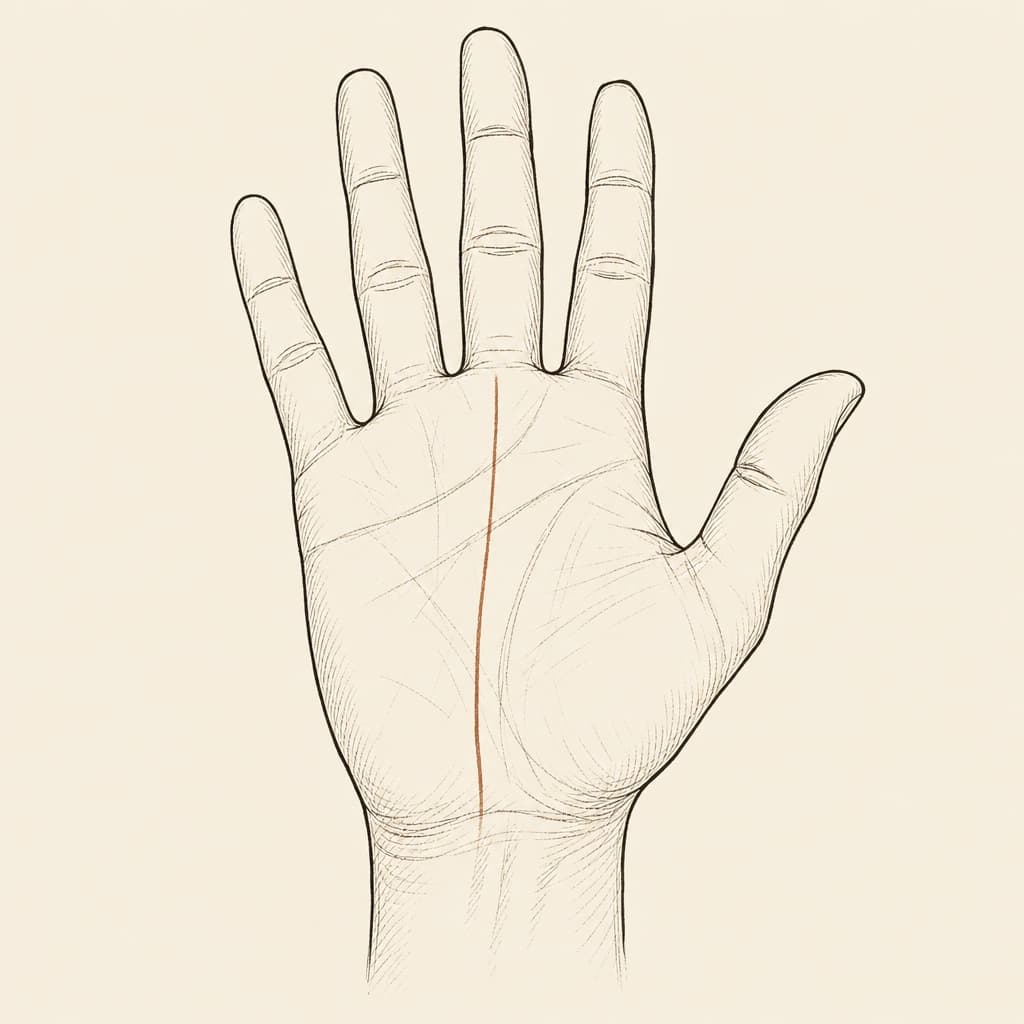
If you can't see a vertical line running up the centre of your palm toward the middle finger, you don't have a fate line — and that is not a problem. Between a quarter and a third of all hands have none. The classical reading is not absence of direction but absence of external structure shaping it. People with no fate line are self-directed: their lives are shaped by their own choices, not by a family business, an institution, or a single visible career arc.
Your fate line — bhagya rekha in Indian palmistry, also called the destiny line or the line of Saturn — is the vertical line that runs up the centre of your palm toward the base of your middle finger. When present, it is read for three things: the direction of your working life, the steadiness of your sense of purpose, and the moments when external circumstance bent the arc of your life into a new shape.
It varies dramatically from hand to hand. Some palms show one running the full length of the palm, deeply etched. Some show one only in the upper portion, beginning partway up. And many show none at all. All three are read meaningfully — as different kinds of life, not as more or less destined.
If you'd like to know whether you have a fate line at all and what it says about your direction, the app reads your palm from a photo.
Where the fate line is and how to find it
Open your dominant hand. Look at the centre of your palm and trace a vertical line from somewhere near the wrist upward toward the middle finger. If you see a line — any line — running roughly along that path, you have a fate line. It may be deep, faint, broken into segments, or may begin only partway up; all of these are read as variations rather than absences.
If you genuinely see no vertical line in the centre of your palm, you are part of the substantial minority of people without a visible fate line. Skip ahead to the section on missing fate lines below — it is the most-asked-about variant.
Where the line begins, and what that says
The starting point of the fate line is one of the most diagnostic features in classical palmistry. It is read for what shaped the early arc of your career or vocation.
A fate line beginning near the wrist — at the base of the palm, low down — is read as an early-determined direction. The person knew what they wanted to do, or had it determined for them, from young. Often associated with people who entered family businesses, followed a parent's vocation, or had clear early signals (musical prodigy, athletic gift, scientific obsession) that set their course.
A fate line beginning from inside the life line — emerging from within the curve of the life line at the start — is read as a career strongly shaped by family. Either the family chose the path, or the family's example, support, or expectation defined what the person ended up doing. This is one of the most common starting positions and is not read as negative; it is the configuration of a person whose vocation grew out of their roots.
A fate line beginning from the Mount of Luna (the percussion side of the palm, near the wrist on the side opposite the thumb) is read as a career shaped by external circumstance and the public. Often associated with public-facing work — performance, politics, teaching, customer-facing professions — and with people whose careers depended substantially on others (audiences, voters, students, clients) recognising and choosing them.
A fate line that begins partway up the palm — not at the wrist but at the head line or higher — is read as a person whose direction emerged late. They may have spent their twenties or thirties without a clear sense of vocation and only found their work after a major decision (a return to study, a career pivot, a change of country) reset their trajectory.
Reading the line: depth, breaks, and where it ends
After the start point, palmists weight the depth of the line, the presence and location of any breaks, and where the line ends.
A deep, well-defined fate line is read as a strong sense of purpose — the person knows, more than most, what they are supposed to be doing. They may not always be doing it; but the conviction that there is a thing for them to do is steady. A faint fate line is read as someone whose direction is more diffuse: still there, but more responsive to circumstance, less driven by a single internal compass.
Breaks in the fate line are among the most important features. A break is read as a major change in life direction — a career pivot, a job loss followed by reinvention, a decision to leave an established path for a different one. Where the break sits on the line gives a rough indication of when the change happened or will happen. A line resuming cleanly after a break — sometimes deeper, sometimes branching — is read as a positive transition. A line that becomes fragmented or fades after a break is read as a more difficult passage that left the person uncertain.
Where the line ends matters. A fate line ending at the heart line is read as a career shaped or shifted by an emotional event — a relationship, a family obligation, a passion that took over. A fate line ending at the head line is read as a career deliberately chosen or redirected by a major decision. A fate line that travels all the way to the base of the middle finger — onto the Mount of Saturn — is the strongest signal of a defined, recognised vocation; it is associated with people whose work becomes their identity in the public eye.
When the fate line is missing entirely
This is the question that comes up most often. The short answer: it is not a problem, and you are in good company.
A missing fate line means that the shape of your life is not being given to you by an obvious external structure. People with strong, deep fate lines tend to have lives organised around a single visible trajectory — a profession, a long-running business, a public role. People with no fate line tend to have lives organised around their own choices, made one at a time, often pivoting and reshaping multiple times across a career. Many entrepreneurs, freelancers, artists, and people who have changed careers two or three times have no fate line.
The classical reading is that a fate line records the influence of fate — meaning, in palmistry's sense, the external forces that shape a life: institutions, family lineage, formal vocations. A missing fate line is the absence of those forces as a defining presence. The person's life is being shaped instead by what classical palmistry calls free will — the accumulated weight of their own decisions.
There is no judgement in either direction. A strong fate line is not a sign of being controlled by destiny; a missing fate line is not a sign of having a more authentic life. They are different ways of having a life. Many palmists pay close attention to the head line in palms with no fate line — the head line tends to do more of the work of indicating direction in those hands, with its trajectory and quality saying more about vocation than it would in a hand where the fate line were also present.
Fate line variations
Deep fate line
A clearly etched, well-defined fate line is read as a strong, steady sense of purpose. People with deep fate lines tend to know what they are for — even if they don't always do it — and tend to be unsettled when their work doesn't feel meaningful. Career changes are felt deeply by these people, sometimes more than relationship changes.
Faint fate line
A barely-visible fate line is read as a person whose direction is real but more flexible. They have a sense of purpose, but it is responsive — it adjusts to circumstance, opportunity, and the people around them. Often associated with people who become good at several adjacent things over time rather than committing to one.
Broken fate line
A clear gap in the line is read as a major career or direction change. A broken fate line that resumes deeper, cleaner, or branching is read as a positive pivot — the change improved the trajectory. A broken fate line that fades or fragments after the break is read as a more difficult passage, often associated with a period of uncertainty before finding the next direction.
Branched fate line
A fate line with branches splitting off — usually upward, toward the fingers — is read as multiple parallel pursuits. Often associated with people whose work has more than one strand: a primary career plus a serious side practice, two distinct vocations held together, a creative life that runs alongside a structured profession.
Fate line starting from the life line
A fate line emerging from inside the life line — beginning from within its curve — is read as a career shaped substantially by family. Family business, family vocation, family support, or family expectation. This is common and not read negatively; it is the configuration of a vocation that grew out of the person's roots.
Fate line starting from the Mount of Luna
A fate line beginning on the percussion side of the palm — near the wrist, on the opposite side from the thumb — is read as a career shaped by the public. Performance, teaching, politics, customer-facing work, or any vocation where being seen and chosen by others determines the trajectory.
Late-starting fate line
A fate line that begins partway up the palm — not at the wrist but at or above the head line — is read as a late-developing direction. The person may have spent their early adult years without a clear sense of vocation, finding their path only after a major decision or transition. Often associated with people who returned to study in their thirties, changed countries, or made a deliberate pivot away from an early track that wasn't working.
Fate line ending at the heart line
A fate line that stops where it meets the heart line is read as a career shaped or interrupted by an emotional event — a marriage that redirected the trajectory, a passion that took over, a family obligation that became central. Not necessarily negative; many people who become primary caregivers or family-business stewards have this configuration.
Fate line ending at the head line
A fate line that stops where it meets the head line is read as a career deliberately redirected by a major decision. The person consciously stepped off one path and onto another — usually with clarity rather than crisis. Often associated with people who left successful careers for ones that mattered more to them.
No fate line
A palm with no visible fate line is in the substantial minority — between a quarter and a third of all palms. The classical reading is not absence of direction but absence of external structure shaping that direction. People with no fate line tend to be self-directed, often entrepreneurial, often having changed careers several times. Their head line and the strength of their thumb tend to do the work of indicating vocation in this configuration.
Common questions
I don't have a fate line. Is that bad?
No. Between a quarter and a third of all palms have no visible fate line, and there is nothing wrong with this. A missing fate line is read as a life shaped by your own choices rather than by external structures. It is the configuration of many entrepreneurs, freelancers, artists, and people who have changed careers more than once. If anything, palms with no fate line require palmists to look more carefully at the head line and the thumb to read for vocation — those features tend to carry more of the load in the absence of a fate line.
My fate line is broken. What does that mean?
A broken fate line is read as a major career change or shift in life direction. If the line resumes cleanly afterward — particularly if it is deeper or branches into multiple paths — the change is read as a positive pivot. If the line fades or fragments after the break, the passage is read as a more difficult one, often involving a period of uncertainty before finding the next direction. The location of the break on the line gives a rough indication of when in life the change occurred or is likely to occur.
Where does the fate line actually start?
The fate line starts somewhere along the bottom half of the palm and travels upward toward the middle finger. Where exactly it starts is one of the most diagnostic features. Common starting points: at the wrist (early-determined vocation), from inside the life line (career shaped by family), from the Mount of Luna on the percussion edge (career shaped by the public), or partway up the palm (late-developing direction).
Is the fate line the same as the destiny line?
Yes. Fate line, destiny line, and line of Saturn are three names for the same line — the vertical line that runs up the centre of the palm. Different palmistry traditions favour different terms. Modern English-language palmistry tends to use "fate line"; older Western texts and some Indian texts prefer "destiny line"; classical Western palmistry following Cheiro often calls it the "line of Saturn" because of where it ends (under the middle finger, on the Mount of Saturn).
Can my fate line change?
Yes — more than the heart and head lines, the fate line is one of the lines most likely to change visibly across a life. New segments appear when a person finds direction; existing segments deepen when commitment grows; breaks open when major changes happen. A palm read at twenty and again at forty often shows a meaningfully different fate line, even when the heart and head lines are largely unchanged.
Related reading
- Heart Line— How you love, how you trust, and what your relational style says about you.
- Head Line— How you think — analytical or intuitive, focused or wide-ranging.
- Sun Line (Apollo Line)— Recognition, reputation, and the part of life where your light shows publicly.
- How to Read Your Palm— The complete beginner's guide — which hand to read, which lines matter, and the order to read them in.