Palmistry
The Sun Line: Recognition, Reputation, and Public Light
The vertical line running up the palm toward the ring finger. Where the fate line maps your sense of direction, the sun line maps the part of your life where your light shows publicly — recognition, reputation, and creative success.
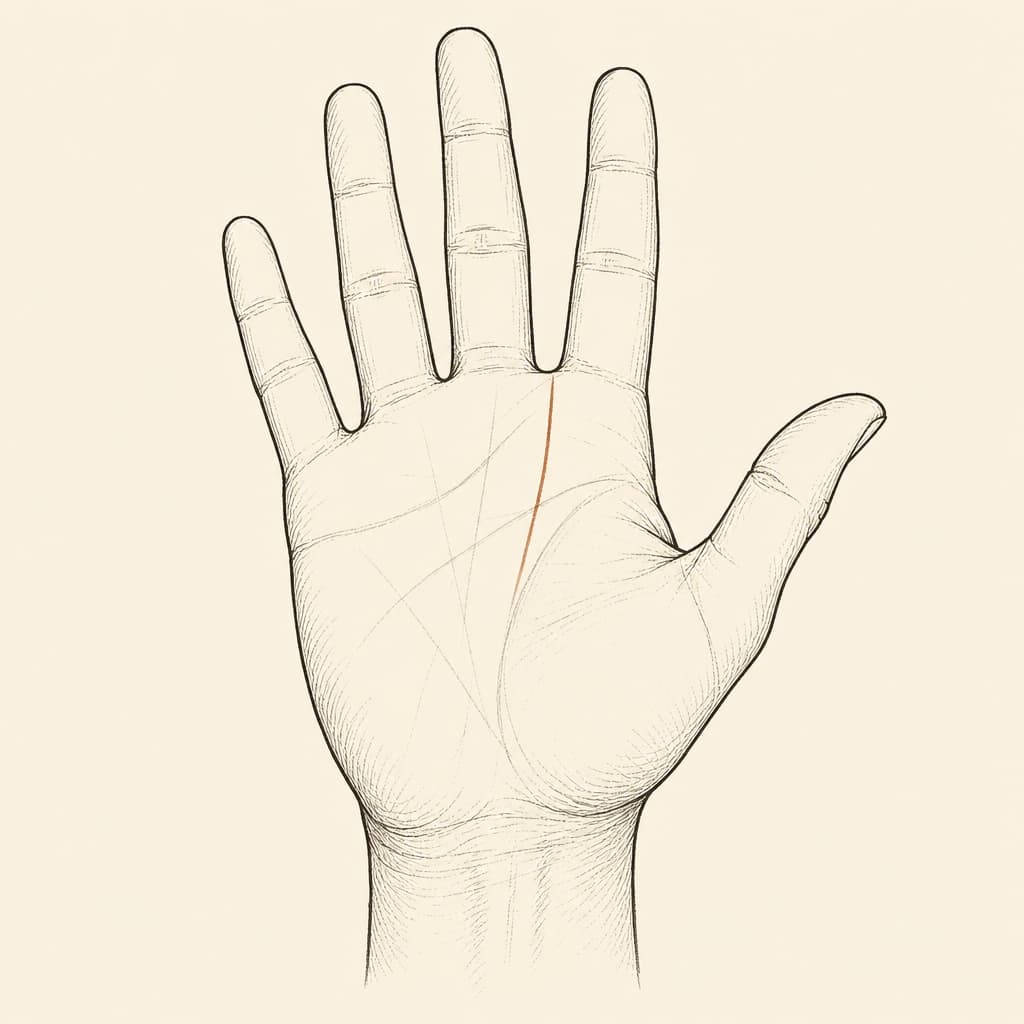
Your sun line — surya rekha in Indian palmistry, also called the Apollo line — is the vertical line that travels up your palm toward the base of your ring finger. It is read for recognition: how visible your work tends to be in the world, how others tend to receive what you do, and whether you are doing the kind of work that suits you. The line's name borrows from the Mount of Apollo at the ring finger's base, which classical palmistry associates with public-facing brilliance.
The sun line is read alongside the fate line, not in place of it. Where the fate line tells you about the structure of your working life, the sun line tells you about how that work is received. A strong fate line with a weak sun line: steady purposeful work that may not bring public recognition. A weak fate line with a strong sun line: a wandering direction that finds recognition wherever it lands. Both strong: a vocation that becomes publicly known, often in a creative or performance-oriented field.
Like the fate line, the sun line varies dramatically. Some palms show a clear, deep one running most of the length of the palm. Many show one only in the upper portion. Many show no sun line at all — not a problem, just information about the kind of life the person lives.
If you'd like to know whether you have a sun line and what it says about how the world tends to receive you, the app reads it from a palm photo.
Where the sun line is and how to find it
Open your dominant hand. Look just under the ring finger and trace downward. If you see a vertical line in the upper portion of your palm — anywhere from just below the ring finger's base down toward the heart line, or further down toward the wrist — you have a sun line. It often appears only in the area between the heart line and the base of the ring finger; this is the most common form.
A sun line that begins lower — at the wrist or partway up the palm — and travels all the way to the Mount of Apollo is the long form, and is uncommon. Most palms show only the upper portion of the line.
What the sun line is read for
Three things, in order of how reliably the line tells you about them: recognition, reputation, and the felt sense of being in your right element.
Recognition is the line's primary association. People with strong sun lines tend to be seen — by colleagues, audiences, clients, communities. The recognition does not have to be fame in the modern celebrity sense; it can be respected expertise within a field, name-recognition within an industry, or local reputation within a community. The line is about visibility and the response to it, not about scale.
Reputation is the line's second association. The sun line records not just whether the person is seen but whether they are seen well. A clean, deep, well-defined sun line is read as a reputation that supports the person — others speak well of them, opportunities come to them through their good name. A fragmented or chained sun line is read as a more ambiguous public presence — recognition that comes with controversy, reputation that requires work to maintain.
The felt sense of being in your right element is the subtler reading. Many palmists treat the sun line as the indicator of whether a person is doing the work they are best suited to. A person with a strong sun line in a job that doesn't suit them often suffers more than other people would in the same situation; the line indicates that they were made for visibility and recognition, and not having it weighs on them. A person with no sun line in the same job may be perfectly content; the visibility their colleagues with sun lines need was never theirs to need.
Reading the line: when it appears, when it deepens
The sun line is one of the lines most likely to develop, deepen, or fade across a life. New segments appear when a person enters a phase of public visibility; existing segments deepen when reputation grows; lines fade when a person retreats from public-facing work.
Where the line begins gives a rough indication of when in life the recognition arrived or will arrive. A sun line that begins low — at the wrist or in the lower palm — is read as recognition that came (or comes) early in life. A sun line that begins partway up the palm — at the head line, or higher — is read as recognition that came later, often after a period of more invisible work.
Breaks in the sun line are read as reputational shifts. A break followed by the line resuming cleanly is read as a positive reset — a public reinvention. A break followed by the line fragmenting or fading is read as a more difficult passage — a reputation lost and not fully recovered.
Sun line variations
Long sun line (full length of palm)
A sun line that travels from the wrist or low in the palm all the way to the Mount of Apollo is rare. Read as a person whose life is substantially defined by public visibility from young — childhood prodigies, family-business heirs raised in the public eye, performers who began early. A particularly fortunate configuration in classical palmistry, though the burden of early visibility is also part of what the line records.
Short sun line (upper palm only)
A sun line that appears only in the upper portion of the palm — between the heart line and the ring finger — is the most common form. Read as recognition that emerges in adulthood, particularly in middle and later life. Often associated with people who do their early work invisibly and are recognised only after years of accumulated reputation.
Deep sun line
A clearly etched, well-defined sun line is read as strong recognition and a reputation that supports the person. Others speak well of them; opportunities come through their name. This is the configuration most associated in classical palmistry with what we now call success — though success in the line's terms is being recognised for what you do, not necessarily being wealthy from it.
Faint sun line
A barely-visible sun line is read as recognition that exists but does not dominate the person's life. They are known by some, valued by some, but they are not their work's public face. Often associated with people who are excellent at what they do and quietly respected within their field, without being celebrities outside it.
Forked sun line
A sun line splitting into multiple branches at its end is read as recognition coming from more than one source — a person known both as an artist and as a teacher, both as an entrepreneur and as a public commentator, two distinct reputations sustained simultaneously. A particularly positive variant in classical palmistry.
Broken sun line
A break in the sun line is read as a reputational shift. The line picking up cleanly afterward — often deeper or branching — is read as a positive reinvention, a public reset that improved the person's standing. A break followed by fragmentation is read as a more difficult passage, often involving public criticism, scandal, or a reputation that took damage and required time to rebuild.
Sun line crossed by lines
Short lines crossing the sun line — particularly horizontal cuts — are read in classical palmistry as obstacles to recognition. Sometimes external (rivals, criticism, public misunderstanding); sometimes internal (the person's own resistance to being seen). The depth of the crossing line indicates the severity of the obstacle.
No sun line
A palm with no visible sun line is common. Read not as the absence of success but as a life that is not built around public recognition. People with no sun line often do important work that is intentionally private: care work, advisory work, the work of being deeply present with a small number of people. Some of the most influential people in any field have no sun line; their influence operates without their being publicly visible.
Common questions
I don't have a sun line. Does that mean I won't be successful?
No. A missing sun line is read as a life that is not built around public recognition — not as a life without success or accomplishment. Many people without sun lines do important work that is intentionally private: care work, advisory work, mentorship, the work of supporting other people's public-facing lives. Success in the sun line's sense is specifically about being publicly seen for what you do; success in the broader human sense doesn't require it.
What is the difference between the sun line and the fate line?
The fate line records your sense of direction and the structure of your working life — what you do. The sun line records how that work is received — whether you become publicly visible for it. They are read together: a strong fate line tells you about your purpose; a strong sun line tells you about your reception. Both can be present, both can be absent, or you can have one without the other.
Why is the sun line called the Apollo line?
Because it travels toward the Mount of Apollo — the raised area at the base of the ring finger, named in classical palmistry for the Greek god Apollo, who governed the sun, music, poetry, and the public-facing arts. The sun line's name borrows from the same association. "Sun line" and "Apollo line" are interchangeable in modern palmistry; older Western texts tend to prefer "Apollo line", and Indian palmistry sometimes calls it the "Surya rekha" using the Sanskrit name for the sun.
My sun line is broken. What does that mean?
A broken sun line is read as a reputational shift — a moment where your public standing changed significantly. If the line resumes cleanly afterward (or deeper, or branching), the change is read as a positive reset: a public reinvention that improved your standing. If the line fragments or fades after the break, the change is read as more difficult: a passage involving criticism, scandal, or reputation lost and slowly rebuilt.
Can my sun line develop later in life?
Yes — more than most lines, the sun line develops, deepens, or fades across a life. New segments appear when a person enters a phase of public visibility; existing segments deepen as recognition grows; lines fade when a person retreats from public-facing work. Many palms show no sun line in the twenties and a clear one by the forties.
Related reading
- Fate Line— Career trajectory, sense of direction, and external forces shaping your path.
- Money Line— Financial intuition and how wealth tends to come to you — earned, gifted, or built.
- Mounts of the Palm— Venus, Jupiter, Saturn, Apollo, Mercury, Mars, Luna — the raised areas that frame how every line is read.
- How to Read Your Palm— The complete beginner's guide — which hand to read, which lines matter, and the order to read them in.