Palmistry
What the Head Line Says About How You Think
The lower of the two long horizontal lines on your palm. Where the heart line maps how you feel, the head line maps how you think — your style of attention, decision, and intellectual engagement.
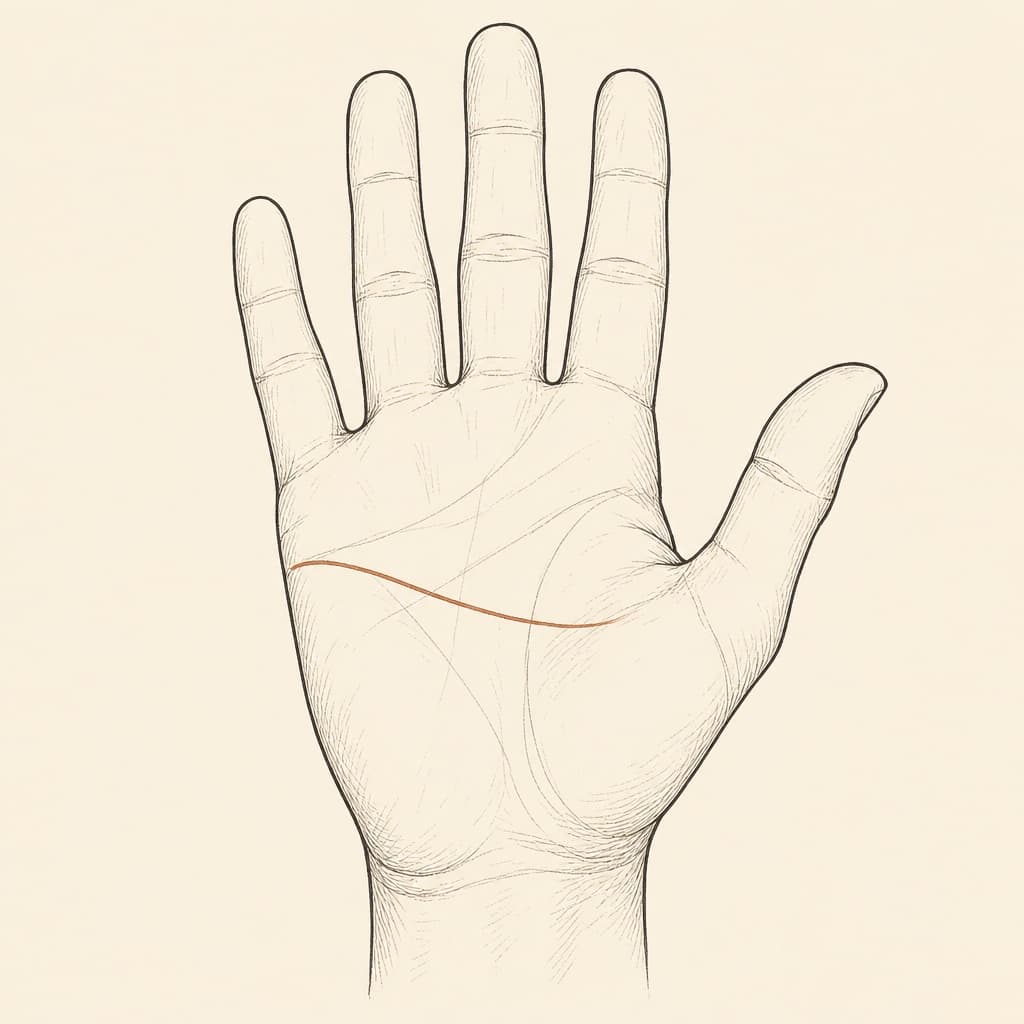
Your head line — mastishk rekha in Indian palmistry — tells you how you think. Whether your reasoning is analytical or intuitive, focused or wide-ranging, structured or associative — and how that style shapes the kind of work you do best. It runs horizontally across your palm just below the heart line, and of all the lines on the palm it is the one palmists weight most heavily when reading for vocation, study, and decision-making.
A clean, well-defined head line indicates a person whose thinking is one of their primary instruments. A faint or fragmented head line is not the absence of intelligence — it is the mark of a thinker whose mind works in less linear ways, often more intuitive, sometimes more creative.
The head line is also one of the two lines — with the heart line — that defines what palmistry calls the rational-emotional balance of the hand. If the head line dominates, the person tends to lead with thought, examining feeling before acting on it. If the heart line dominates, feeling tends to come first. Most hands show one of the two as slightly stronger; truly balanced hands are read as a particularly integrated personality.
If you'd like to know what your own head line says about your thinking style, the app reads it from a palm photo and walks you through what it sees.
How to find the head line
Open your dominant hand. The head line is the longer horizontal line crossing your palm just below the heart line. It begins on the thumb side — usually between the thumb and index finger, often touching or joined to the start of the life line — and travels across toward the percussion edge.
Where the head line ends is a major diagnostic. The three classical end positions are: straight across (ending under the little finger), gently curving downward toward the wrist, or sharply diving down toward the base of the palm. Each of these end positions is read as a different cognitive style.
The three classical endings
A head line that travels straight across the palm — staying horizontal, ending under the little finger or close to the percussion edge — is read as the analytical mind. People with this configuration tend to think in linear, structured, fact-based ways. They want premises, evidence, and conclusions in that order. They are often drawn to fields with clear rules and verifiable results: engineering, finance, law, medicine, programming. The shadow side is over-reliance on logic when a problem actually requires feeling or intuition; they may dismiss what they cannot reason their way to.
A head line that gently curves downward as it crosses the palm — ending in the upper-middle portion of the palm rather than at the percussion edge — is the imaginative mind. People with this line are read as thinkers who range widely, draw on intuition and association as much as on logic, and often find their best ideas in unexpected combinations. They are often drawn to writing, design, teaching, therapy, or any field where ideas must connect with people. The shadow side is difficulty staying with a single line of thought long enough to finish what they started.
A head line that dives sharply downward toward the base of the palm — heading toward the Mount of Luna near the wrist — is the deeply imaginative or romantic mind. The Mount of Luna is associated in palmistry with imagination, intuition, and the unconscious. A head line that aims for it is read as a mind that operates substantially in the imaginative or symbolic register: poets, novelists, mystics, designers of speculative things. The shadow side is escapism — a tendency to retreat from practical demands into the inner world.
Length, depth, and clarity
After the end point, palmists read the line for length, depth, and clarity, just as with the heart line — but the meanings shift to the cognitive register.
Length is read as range of attention. A long head line that reaches across the entire palm indicates a wide-ranging thinker — someone who follows many threads, takes interest in many subjects, and tends to know something about a lot of things. A short head line, ending near the centre of the palm, indicates a focused thinker — someone who goes deep on a smaller number of topics and is less easily distracted by adjacent subjects. Neither is better; both are powerful in different fields.
Depth is read as the substance of thought. A deeply etched head line indicates a person whose thinking carries weight — careful, considered, able to hold complexity. A faint head line indicates a quicker, more associative mode of thinking — sometimes brilliant in flashes, less suited to sustained heavy reasoning.
Clarity — whether the line is clean and continuous or chained, broken, or fragmented — is read as the steadiness of attention. A clean line indicates focused, sustained thinking; a fragmented line indicates a mind that jumps, sometimes productively (creative leaps) and sometimes unproductively (distractibility, rumination).
The head line and the life line at the start
How the head line begins relative to the life line is one of the most diagnostic features in classical palmistry. Three configurations are common.
The two lines joined at the start — sharing a starting point and travelling together briefly before separating — is read as a person who grew up under strong family influence and whose intellectual confidence developed in dialogue with (and sometimes against) those expectations. The longer the lines travel together before separating, the longer it took the person to find their own intellectual voice. This is the most common configuration.
The two lines beginning separately, with a clear gap between them — is read as early independence. A person who thinks for themselves from young, sometimes to the consternation of their family. This configuration is associated with entrepreneurs, early migrants, and people who left home (literally or metaphorically) early.
The head line beginning inside the life line — starting from within the curve of the life line, passing through it as it crosses the palm — is read as caution. A thinker who weighs decisions carefully, sometimes too carefully, and who tends to defer to family or institutional authority before acting on their own judgment.
Head line variations
Straight head line
A head line travelling horizontally across the palm with little or no downward curve is the straight variant. Read as the analytical, fact-based, structured thinker. Excellent at problems with knowable answers; sometimes impatient with problems that don't have them. Often pairs well with a deep heart line — the combination of strong feeling held in disciplined thinking.
Curved head line
A head line that bends downward as it crosses the palm, ending in the upper-middle portion of the palm or angling toward the base, is the curved variant. Read as the imaginative, associative, creative thinker. Strong at synthesising disparate inputs; sometimes weak at staying on a single line of thought.
Long head line
A head line that travels all the way across the palm to the percussion edge is the long variant. Read as a wide-ranging mind: many interests, broad knowledge, the kind of person who reads multiple newspapers and remembers what they read. The shadow: spreads attention across many things and may struggle to commit to a single specialty.
Short head line
A head line that stops in the middle of the palm or earlier is the short variant. Read as a focused mind: fewer subjects, deeper engagement, less distractibility. People with short head lines often become subject-matter specialists — they know one thing very well rather than many things passably.
Forked head line (writer's fork)
A head line that splits into two branches at its end — one continuing horizontally and one curving downward — is the forked variant, sometimes called the writer's fork. It is read as a person who can hold both modes simultaneously: practical-analytical thinking and imaginative-associative thinking, deployed as needed. Highly fortunate in palmistry; over-represented in successful writers, designers, and strategists.
Broken head line
A head line interrupted by a clear gap is the broken variant. Read as a major change in thinking — sometimes triggered by a specific event (an illness, a traumatic experience, a transformative book or teacher), sometimes a gradual shift that the line records as a discontinuity. The line picking up afterward is read as a new mode of thinking; if the new line is cleaner or deeper than the old, the change is read as growth.
Chained head line
A head line that appears as a series of small linked loops rather than a clean continuous line is the chained variant. Read as a mind that ruminates — circles around problems, returns to topics, holds onto thoughts longer than necessary. Associated with anxiety in the more difficult expressions, with thoroughness and persistence in the more productive ones.
Head line dipping to the Mount of Luna
A head line that bends sharply downward as it crosses the palm, heading toward the wrist on the percussion side (the Mount of Luna), is the mystic variant. Read as a deeply imaginative mind, often with strong intuitive or symbolic capacities. Common in writers, artists, and people in contemplative or therapeutic professions.
Doubled head line
In rare cases a second head line runs parallel to the main one. Read as a particularly versatile mind — capable of holding two distinct ways of thinking simultaneously, able to switch registers fluently. Often found in people whose work combines very different fields (a doctor who is also a writer; an engineer who is also a musician).
Simian line (head and heart fused)
When the head line and heart line are fused into a single horizontal line crossing the palm, it is the simian line. Read as a particularly intense personality — when this person commits to a thought or a feeling, the other comes with it. Hard to think without feeling, hard to feel without thinking. Powerful in focused work, challenging in situations that require dispassionate analysis.
Common questions
What's the difference between the head line and the heart line?
The head line is the lower of the two long horizontal lines on your palm; the heart line is the upper one. The head line is read for how you think — your style of reasoning, attention, and decision. The heart line is read for how you feel — your style of attachment, expression, and emotional engagement. Both are major lines in palmistry; their relationship to each other (which is deeper, which is longer, whether they are balanced) is one of the most informative readings the hand offers.
Does a long head line mean I am intelligent?
No. A long head line indicates a wide-ranging thinker — someone whose attention spans many subjects — but does not measure intellectual power. People with short head lines can be deeply intelligent in focused ways; people with faint head lines can be intuitively brilliant. The line tells you about the style of your thinking, not its quality.
My head line and life line are joined at the start. Is that bad?
It is not bad — it is the most common configuration. It is read as a person whose intellectual development was strongly shaped by family expectations early on. The lines separating after a short distance shows the moment of independent thinking emerging. It does not mean you are dependent or weak-willed; it means your thinking developed in dialogue with your origins, which is true for most people.
What does it mean if my head line dips down sharply at the end?
A head line that dives toward the base of the palm — heading for the Mount of Luna near the wrist — is read as a deeply imaginative or intuitive mind. The Mount of Luna is associated in palmistry with imagination, the unconscious, and the symbolic. People with this configuration often work in creative, therapeutic, or contemplative fields. The shadow side is a tendency to retreat from practical demands into the inner world.
I have a fork at the end of my head line. What does that mean?
A forked head line is one of the most positive readings in palmistry, sometimes called the writer's fork. It indicates a mind that can hold two modes simultaneously: analytical thinking and imaginative thinking, practical reasoning and creative association. People with forked head lines are often able to deploy whichever mode the situation requires, and many are over-represented in writing, design, and strategy work.
Related reading
- Heart Line— How you love, how you trust, and what your relational style says about you.
- Life Line— Vitality, energy, and the rhythm of how you move through change — not, contrary to myth, lifespan.
- Fate Line— Career trajectory, sense of direction, and external forces shaping your path.
- How to Read Your Palm— The complete beginner's guide — which hand to read, which lines matter, and the order to read them in.