Palmistry
What the Life Line Really Means
The curved line that wraps around the base of the thumb. It is read for vitality, energy, and how you handle change — not, contrary to a stubborn myth, for how long you will live.
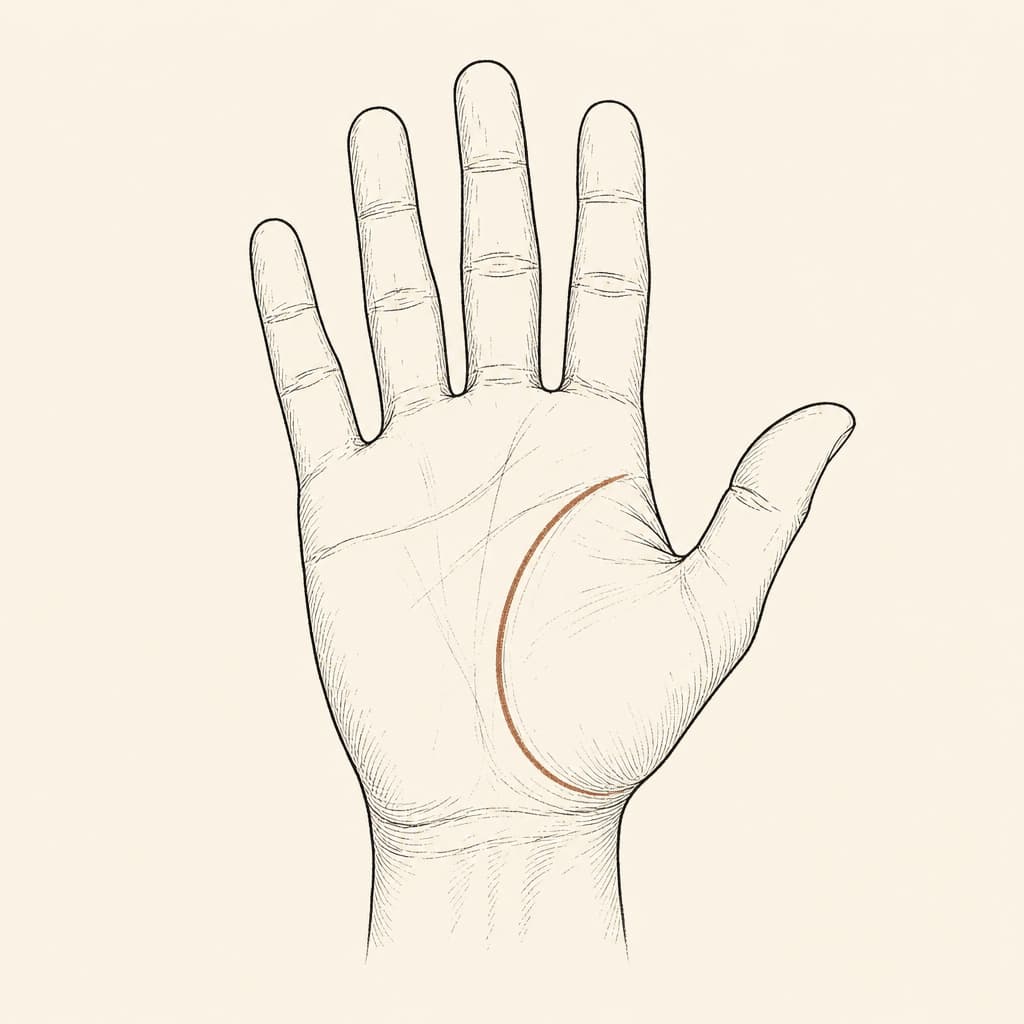
The most common belief about your life line — that its length predicts how long you will live — is wrong. It has been wrong in every serious palmistry tradition. People with very short life lines live full, long lives. People whose life lines wrap around the wrist die in their forties. The line is not a clock, and a palmist who tells you otherwise is not a palmist.
Your life line — jeevan rekha in Indian palmistry — is the curved line that wraps around the base of your thumb. What it actually maps is something subtler: the quality of your vital energy, your physical resilience, and how your body responds to change. A short, deep life line belongs to someone with focused, intense vitality. A long, faint line belongs to someone whose energy is more diffuse but lasts longer. These are descriptions of how you move through life, not of how long you have.
It is the second most-read line in palmistry, after the heart line, and the first one most people instinctively look at on their own hand — usually because of the lifespan myth. With that out of the way, the rest of this page covers what the line genuinely is for: the start point, the depth, the sweep, the Mount of Venus inside its arc, and the variations palmistry actually pays attention to.
If you'd like to skip the magnifying glass and see what your own life line actually says, the app reads your palm from a photo and walks you through what it finds.
Why the lifespan myth is wrong
Because this myth is so persistent and causes so much unnecessary worry, it is worth being explicit about why it doesn't hold up. There is no documented correspondence in any palmistry tradition between the length of the life line and the duration of the life. Cheiro himself was explicit about it. Vedic palmistry never read the line that way. The myth is a Victorian-era folk simplification that took on a life of its own and refuses to die.
What the line's length is actually read for is reach — how far your physical-vitality theme extends through your life. A short line that reaches only the middle of the palm can be read as a person whose physical vitality is most pronounced in early and middle life, with later years better described by other lines (the fate line, the sun line). A long line that wraps fully around the thumb is read as a person whose body remains a defining theme into late life — for better or worse.
If a palmist tells you your life line means you will die young, you have not met a palmist. You have met a fortune-teller using palmistry vocabulary, and the polite thing to do is leave.
Where the life line is and how to find it
Open your dominant hand, palm up. The life line is the curved line that starts somewhere between your thumb and index finger and arcs downward, wrapping around the fleshy base of your thumb. It frames what palmists call the Mount of Venus — the rounded pad at the thumb's base associated in palmistry with vitality, sensuality, and the appetite for living.
Where the line begins is one of its most diagnostic features. Three classical starting positions: high (touching or close to the head line at the index finger's base), middle (in the gap between thumb and index), or joined directly to the head line. Where the line ends — close to the wrist, or curving back toward the centre of the palm — gives the second major diagnostic.
What the line is actually read for
Three things together: vitality, the texture of your energy, and how you respond to change.
Vitality, in the palmistry sense, is not a measure of how long you will live. It is a measure of how present you are in your body — your physical baseline, your appetite for activity, your default level of alertness. A person with a deep, well-defined life line is read as physically present, in tune with their body, and quick to recover from illness or exhaustion. A person with a faint or fragmented life line is not read as weak — but as someone whose energy comes and goes, who needs to manage their reserves more carefully than most.
The texture of your energy refers to whether you operate in bursts or in steady output. A short, deep, highly defined life line belongs to someone who runs hot and rests fully — the kind of person who can produce intense work for a season and then needs a long quiet period before doing it again. A long, even-depth life line belongs to someone whose energy is more like a slow flame: less dramatic, harder to derail, sustained over decades.
Response to change is the third reading. Breaks, branches, and shifts in the life line are read by classical palmistry not as catastrophe but as significant transitions — moves, career pivots, relationship changes, the kind of life events that genuinely reshape how you live. The line picking up after a break is read as the same person living a different life.
Reading the line: depth, distance, and the Mount of Venus
After the start point, classical palmistry weights three features: the depth of the line, how widely it sweeps (how much area it encloses around the thumb), and the condition of the Mount of Venus inside its arc.
A deep, well-defined line is the strongest signal of vitality the hand can give. It indicates someone whose physical baseline is high, who tends to recover quickly from illness, and who is rarely the first person in the room to be tired.
How widely the line sweeps tells you about your appetite for life. A line that arcs out widely, enclosing a large Mount of Venus, is read as a generous, sensual, life-loving temperament — the person who orders dessert, books one more day on the trip, says yes to the spontaneous plan. A line that hugs the thumb closely, leaving a small Mount of Venus, is read as a more contained relationship with physical pleasure: a person who keeps their appetites restrained, sometimes virtuously, sometimes overly so.
The Mount of Venus itself — the fleshy area inside the arc of the life line — is the part most palmists examine alongside the life line. A firm, well-rounded Mount of Venus is read as healthy life-force, sexual vitality, and warmth toward people. A flat or undeveloped Mount of Venus is read as a person whose physicality is less central to how they engage with the world; they may be more cerebral, more spiritual, or simply more reserved.
Life line variations
These are the configurations clients ask about most often. As with the heart line, many palms show several at once — the readings layer rather than override.
Short life line
A life line that ends well before reaching the wrist — sometimes stopping in the middle of the palm — is the short variant. Read as: focused, intense, project-oriented vitality. People with short life lines are often described as having "missions" — they pour themselves into specific phases of life and rest visibly between them. This has nothing to do with how long they will live.
Long life line
A life line that wraps fully around the base of the thumb and reaches close to the wrist is the long variant. Read as: sustained, steady physical presence across the full arc of life. Often associated with people who remain physically engaged into older age — gardeners, dancers, long-distance walkers, people whose bodies remain part of who they are.
Deep life line
A line you can feel as a groove when you run your finger across it is the deep variant. The strongest single signal of robust vitality in classical palmistry. Quick recovery, high baseline energy, often a persistent appetite for activity that outlasts other people's.
Faint life line
A line that is hard to see clearly — often described as silvery or hairline — is the faint variant. This is not weakness; it is delicacy. Read as a person whose energy is more diffuse, who needs more careful management of rest and stimulation, and who often has rich internal life that takes precedence over external action. Many writers, designers, and contemplatives have faint life lines.
Broken life line
A clear gap in the line — the line stopping and resuming somewhere else — is the broken variant. The classical reading is a major life transition: moving country, changing career completely, the end of one significant chapter and the beginning of another. The line picking up after a break, especially with a fresh quality (deeper, more defined), is read as a positive transition — a reinvention. A break followed by a fragmented or weakened line continuing is read as a more difficult passage.
Critically: a broken life line is not read as imminent death. The Victorian folk reading attached this meaning, but no serious tradition supports it.
Branched life line
A small line splitting off from the life line — usually heading inward toward the centre of the palm — is a branch. Inward branches are often read as significant relationships or new chapters that pull the person's energy in a new direction (a marriage, a child, a major friendship that becomes formative). Outward branches — heading toward the thumb — are rarer and read as energy lost to specific projects or commitments that did not return what was put in.
Doubled life line (sister line)
In some palms a second, parallel line runs alongside the main life line on the inside (closer to the thumb). This is sometimes called a sister line, Mars line, or guardian line. Both Vedic and Western palmistry read it as a positive feature: extra protection, extra reserves, often an indicator of a person who has weathered something significant and emerged with reinforced strength.
Life line joined to the head line at the start
When the life line and head line begin from the same point, joined together, it is read as a person whose early life was strongly influenced by family expectations and the cautious-thinking habits of their upbringing. The two lines separating after a short distance shows the point at which the person's independent thinking emerged. A long join — lines that travel together for a substantial distance before separating — is read as a person who took longer to find their own voice.
Life line separated from the head line at the start
When the life line and head line begin separately, with a clear gap between them at the start, the reading is the opposite: an early-developed independence, sometimes a willingness to take risks before others would think it wise. Often read as the entrepreneur's start, the young migrant's start, the rebellious-teenager's start.
Chained or fragmented life line
A line that appears as a sequence of small linked loops or breaks rather than a clean continuous mark is the chained variant. Read as periods of physical or emotional vulnerability — recurring illnesses, anxiety, sustained stress. The chained section corresponds to the period of life it sits in (early, middle, late), with chaining typically resolving into a cleaner line afterward if the period was overcome.
Common questions
Does a short life line mean I will die young?
No. This is the single most common misconception in palmistry and it is wrong. The length of the life line is not read in any serious palmistry tradition as predicting lifespan. People with very short life lines live full, long lives. What life line length is read for is reach — how far the theme of physical vitality extends through your life — not when your life ends.
My life line is broken. Should I be worried?
No. A broken life line is read as a significant life transition — a major move, career change, the end of one chapter and start of another. It is not read as a prediction of catastrophe or death. Many people develop breaks in their life line in midlife as their lives reshape; the line picking up cleanly afterward is generally read as a positive transition.
What does it mean if my life line is very faint?
A faint life line is read as a delicate physical constitution — someone whose energy is best managed with attention to rest, sleep, and recovery. It is not read as imminent ill health. Many people with strong inner lives, creative careers, or contemplative dispositions have faint life lines because their primary mode of engagement with the world is internal rather than physical.
I have two life lines. What does that mean?
A second line running parallel to the main life line on the thumb side is called a sister line (or Mars line, or guardian line, depending on tradition). It is read as a positive feature in both Vedic and Western palmistry — extra protection, extra reserves of energy, and often a sign of someone who has come through a difficult passage with strengthened rather than diminished vitality.
Where does the life line actually start?
The life line starts somewhere in the area between your thumb and index finger. The exact starting position is itself diagnostic: a line starting high (close to the index finger's base) is read as ambitious, driven, with strong early-life direction. A line starting in the middle of the gap between thumb and index is the most common position and reads as balanced. A line that begins inside the head line — joined to it — is read as a more cautious, family-influenced start.
Related reading
- Heart Line— How you love, how you trust, and what your relational style says about you.
- Head Line— How you think — analytical or intuitive, focused or wide-ranging.
- Fate Line— Career trajectory, sense of direction, and external forces shaping your path.
- Mounts of the Palm— Venus, Jupiter, Saturn, Apollo, Mercury, Mars, Luna — the raised areas that frame how every line is read.