Palmistry
The Health Line: Constitution and Vitality
A diagonal line running from near the base of the thumb upward toward the little finger. It is the line palmistry treats most carefully — read for physical constitution, not for medical diagnosis, and historically read with the explicit caveat that its absence is the most positive sign of all.
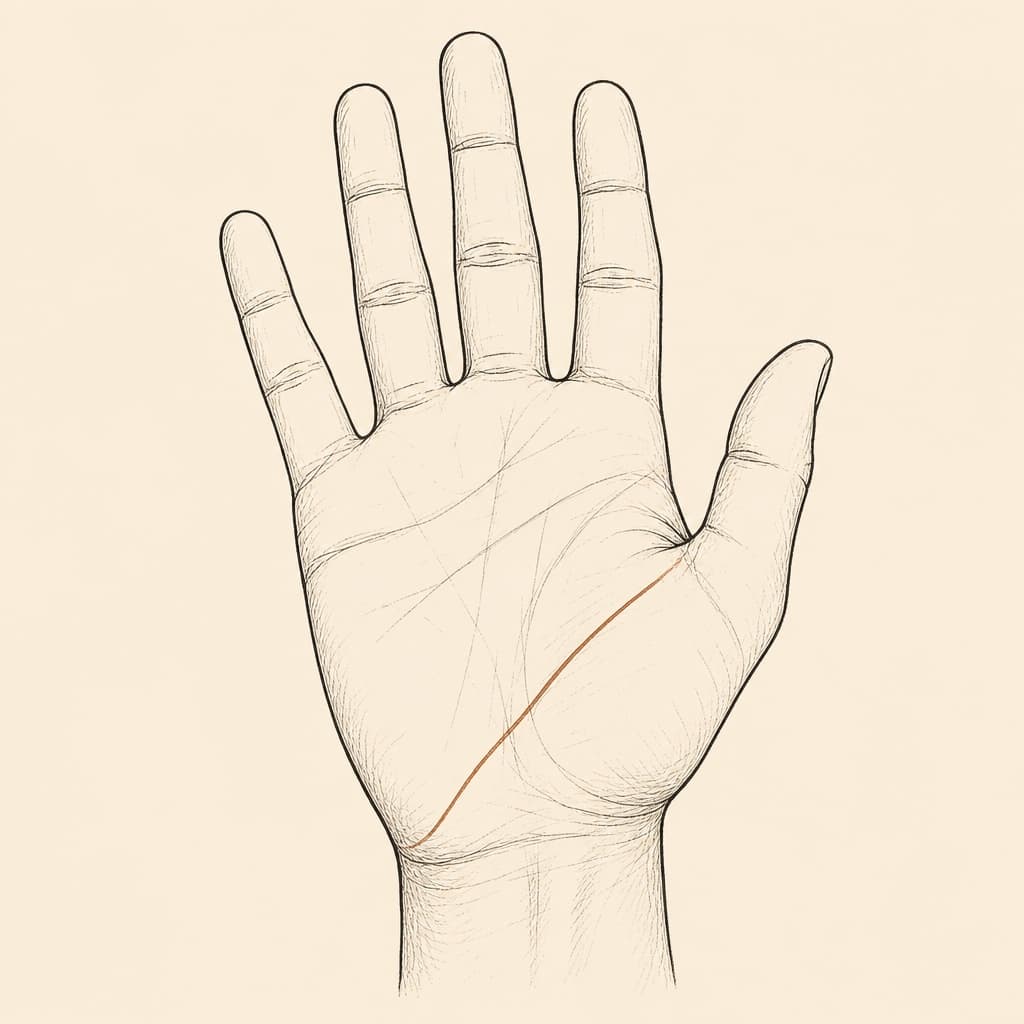
If you don't see a diagonal line running from the lower part of your palm up toward your little finger, you don't have a health line — and that is the most positive sign in this region of the hand. Classical palmistry reads a missing health line as a person whose physical constitution is strong enough that their health is simply not a defining theme of their life.
Before reading anything else about the line itself: the health line, when present, is read for general physical constitution and how the body responds to stress — not for medical diagnosis. No serious palmist diagnoses illness from the lines. If you have a health concern, see a doctor; do not substitute a palm reading for medical care.
When the health line is present, it indicates that physical constitution is a notable theme in your life. A clean, deep, well-defined line indicates a strong but conscious constitution — someone who has worked out what their body needs and tends to it. A faint or fragmented line indicates a more sensitive constitution that benefits from careful management. None of these is weakness; they are descriptions of how your body sits in your life.
If you'd like to see whether your palm shows a health line at all and what it might be saying, the app reads it from a photo.
Where the health line is
Look at your dominant hand. The health line, when present, runs diagonally from somewhere in the lower portion of the palm — often near the base of the thumb or the wrist — upward and across the palm toward the base of the little finger. It is one of the harder lines to identify because it can begin in several places and travel along several paths.
If you don't see a clear diagonal line in this region of your palm, you almost certainly don't have a health line — and that is, in classical palmistry, a positive sign rather than a missing feature.
What the line is read for
The health line's presence at all means that physical constitution is a notable feature of the person's life — they think about their health, manage their physical reserves consciously, or have lived through significant illness or recovery. The absence of the line means physical constitution is simply not in the foreground; the person's body works without their having to think about it much.
When present, the line is read for three things: the quality of constitution, the relationship between mind and body, and patterns of physical sensitivity.
Quality of constitution is read from the line's clarity. A clean, deep, well-defined health line indicates a person with a strong but conscious constitution — someone who has worked out what their body needs and tends to it. A faint, chained, or fragmented line is read as a more sensitive constitution that requires more management; not weakness, but awareness.
The relationship between mind and body — particularly the somatic experience of stress — is read from how the health line interacts with the head line. A health line that crosses or touches the head line is read as a person whose physical wellbeing is closely tied to their mental state; stress shows up in the body quickly. This is information about somatic-emotional integration, not a diagnosis.
Patterns of physical sensitivity — particular vulnerabilities or strengths — are read from breaks, islands, and crossings on the line. Classical palmistry attached specific organ associations to specific positions on the health line, but modern palmists are appropriately cautious about these readings, which veered into pseudo-diagnosis.
A note on responsible reading
The health line is the line where palmistry must be most careful. Historically, some traditions read specific organ vulnerabilities into specific marks on the line — a particular island for kidney trouble, a particular break for heart trouble, and so on. These readings have a long history but no clinical basis, and they have caused real harm when people delayed medical care because their palmist did or didn't see something.
Modern responsible palmistry reads the health line only for what it can credibly tell — broad constitution, somatic-emotional patterns, the general theme of physical attention in a person's life. It does not read specific organ-by-organ predictions. If a palmist tells you, from your palm alone, that you have a specific medical condition, treat that as folk reading rather than reliable information, and follow up with an actual doctor for anything that concerns you.
Health line variations
No visible health line
A palm with no visible health line is read as the most positive configuration in this region. The absence indicates a person whose physical constitution is strong enough that their health does not register as a major theme of their life — they don't think about it much because they don't have to.
Clean, deep health line
A clearly etched, well-defined health line is read as a person who has a notable constitution — often someone aware of their physical needs, often someone who has worked out what their body requires and tends to it deliberately. Not negative; the person's health is conscious rather than absent from awareness.
Faint health line
A barely-visible health line is read as low-grade physical sensitivity — a body that responds to stress, weather, sleep changes, but is not significantly impaired. The person tends to need to manage their physical baseline more than average, but their constitution is not weak.
Chained or fragmented health line
A health line made of small linked loops or broken into segments is read as periods of physical vulnerability — recurring illnesses, chronic low-grade conditions, sustained stress that has expressed itself in the body. The chained sections often correspond to the periods of life they sit in.
Health line crossing the head line
A health line that crosses or touches the head line is read as a strong somatic-emotional connection — the person's mental and emotional state shows up in their body quickly. Stress becomes physical symptoms; emotional events have physical consequences. Information about how to manage one's health, not a diagnosis.
Health line crossing the life line
A health line that crosses the life line is read in classical palmistry as periods of significant physical demand on the person's baseline vitality — illness, prolonged stress, periods of caretaking that drained reserves. Not predictive of specific outcomes; descriptive of patterns.
Common questions
I don't have a health line. Is that bad?
No — it is the most positive sign in this region of the palm. Classical palmistry has consistently read a missing health line as the configuration of a person whose physical constitution is strong enough that health is not a defining theme of their life. They don't think about their body much because their body works without requiring much attention.
Can my palm tell me if I have a specific illness?
No, and any palmist who claims otherwise is overreading the line and potentially causing harm. The health line, when present, can indicate the broad theme of physical constitution and the body's response to stress — useful self-knowledge. It cannot diagnose specific medical conditions. If you have a health concern, see a doctor; do not substitute palm reading for medical attention.
Why is the health line sometimes called the line of Mercury?
Because it travels toward the Mount of Mercury — the raised area at the base of the little finger. The little finger is associated in classical palmistry with Mercury (the Roman god of communication, commerce, and quick intelligence). The line of Mercury is one classical name for the same line; the term "health line" is more common in modern palmistry, particularly in the Indian tradition.
My health line is broken. What does that mean?
A break in the health line is read as a period of significant change in the person's physical constitution — sometimes an illness, sometimes a recovery from illness, sometimes a major lifestyle change that reshaped the body. The line resuming cleanly afterward is read as a positive transition; the line fragmenting after the break is read as a more difficult passage.
Related reading
- Life Line— Vitality, energy, and the rhythm of how you move through change — not, contrary to myth, lifespan.
- Head Line— How you think — analytical or intuitive, focused or wide-ranging.
- Mounts of the Palm— Venus, Jupiter, Saturn, Apollo, Mercury, Mars, Luna — the raised areas that frame how every line is read.
- How to Read Your Palm— The complete beginner's guide — which hand to read, which lines matter, and the order to read them in.