Palmistry
The Seven Mounts of the Palm
The raised areas of the palm — small fleshy pads under each finger and at certain other positions. They frame how every line is read, and they have their own readings independent of the lines.
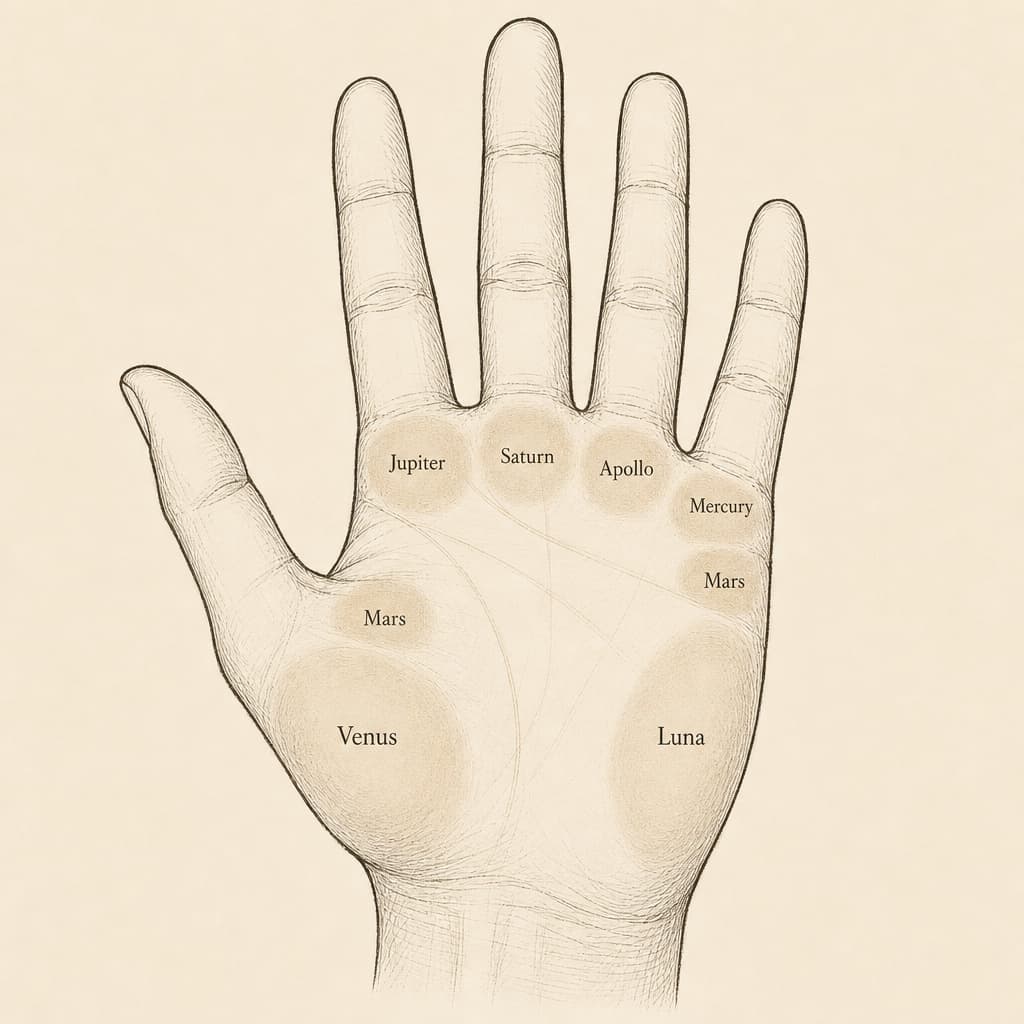
The mounts of your palm are the seven raised, fleshy areas distributed across your hand — the small pads under each finger, the larger ones at the base of your thumb (Mount of Venus) and on the percussion edge (Mount of Luna), plus the two Mars mounts. Each is named after a Roman god — or, equivalently, a planetary archetype — and each carries an associated quality of character: vitality on Venus, ambition on Jupiter, discipline on Saturn, creativity on Apollo, quickness on Mercury, courage on the two Marses, imagination on Luna. Indian palmistry uses the Sanskrit names (Shukra for Venus, Guru for Jupiter, Shani for Saturn, and so on) but the correspondences are the same.
Mounts matter for two reasons. First, they have their own readings: the prominence of each mount indicates how strong that quality is in the person. Second, they frame how every line on the palm is read. A heart line ending on a strong Mount of Jupiter reads differently from one ending on a weak one. A fate line beginning from a prominent Mount of Luna reads differently from one beginning at the wrist. Every line's meaning is partly given by the mount it travels through.
Reading the mounts is the part of palmistry most beginners skip and most experienced palmists rely on. It also responds most to looking at the hand in person — the difference between a firm and a flat mount is something you feel as much as see. For your own palm, the easiest test is to press lightly on each mount with your other thumb and notice which areas resist the pressure and which give way.
If you'd like to know which mounts on your own palm are most prominent — and what that says about your temperament — the app reads them from a photo.
Mount of Venus — under the thumb
The Mount of Venus is the large fleshy area at the base of the thumb, enclosed by the curve of the life line. Of all the mounts, it is the largest and usually the most prominent. It is read for vitality, sensuality, the appetite for living, and the warmth a person brings to physical and emotional life.
A firm, well-rounded Mount of Venus is read as strong life-force — the person enjoys their body, enjoys other people, and brings warmth into their relationships. They are often described as physically present in a way that makes others feel engaged with them. The shadow side of an over-developed Mount of Venus is over-indulgence — the person's appetites can dominate, sometimes to their cost.
A flat or hollow Mount of Venus is read as a person whose physicality is less central to how they engage with the world — more cerebral, more spiritual, sometimes more reserved. Often present in palms of contemplative or ascetic people; not negative, but a different orientation.
Mount of Jupiter — under the index finger
The Mount of Jupiter sits at the base of the index finger. It is the mount associated with ambition, leadership, idealism, and the appetite for being seen. The index finger itself has long been associated with command (think of pointing, of leadership gestures, of the gesture of swearing an oath); the mount under it carries the same theme.
A firm, well-developed Mount of Jupiter is read as healthy ambition — the person wants to do significant things, wants their work to matter, wants to lead in some sense. They tend to be drawn to roles of responsibility and to be uncomfortable in situations where they feel under-utilised. The shadow side is over-prominence — the kind of leadership ambition that becomes domination, the kind of idealism that becomes self-righteousness.
A flat or undeveloped Mount of Jupiter is read as a person whose ambition is muted — they may be perfectly capable but they don't orient their lives around being seen or leading. Often present in palms of people who are content as second-in-commands, as supportive professionals, as the people who make others' work possible.
Mount of Saturn — under the middle finger
The Mount of Saturn sits at the base of the middle finger. Saturn in the planetary tradition governs responsibility, discipline, time, limitation, and the serious side of life. The mount carries the same associations.
A firm Mount of Saturn is read as a person whose seriousness is well-developed — they take responsibility, they understand limits, they are willing to do difficult work. Often present in palms of people in demanding professions: surgeons, judges, engineers, builders, anyone whose work consequences are immediate and substantial. The shadow side is over-prominence — the person who cannot stop working, who treats ease as suspicious, who is uncomfortable with celebration.
A flat Mount of Saturn is read as a person whose relationship to discipline and limit is more flexible — they may be capable of seriousness when needed, but they do not lead with it. Often present in palms of people whose work is more playful, exploratory, or improvisational.
Mount of Apollo — under the ring finger
The Mount of Apollo sits at the base of the ring finger. Apollo in the classical tradition is the god of the sun, of music and poetry, of the public-facing arts. The mount is associated with creativity, recognition, charisma, and the part of the person that wants to shine.
A firm Mount of Apollo is read as a person with genuine creative or expressive capacity, often with the additional quality of wanting that capacity recognised. They are often drawn to artistic work, to performance, to fields where their distinctive contribution is visible. The shadow side is over-prominence — the need for recognition becoming a vulnerability, the discomfort with anonymity becoming a dependence on applause.
A flat Mount of Apollo is read as a person whose creative or expressive impulse is more private — they may be deeply imaginative or skilled, but they do not need it to be publicly seen. Often present in palms of behind-the-scenes professionals and of artists who genuinely work for the work's sake.
Mount of Mercury — under the little finger
The Mount of Mercury sits at the base of the little finger. Mercury, the messenger god, governs communication, commerce, quickness, and dealings with people. The mount is associated with the same: verbal facility, business sense, social intelligence, the ability to read situations and respond quickly.
A firm Mount of Mercury is read as quick intelligence — verbal, social, financial, often all three. People with strong Mercury mounts tend to be good talkers, good negotiators, and alert to opportunities others miss. Often present in palms of journalists, traders, salespeople, lawyers, and entrepreneurs. The shadow side is over-prominence — quickness becoming superficiality, communicative facility becoming manipulation.
A flat Mount of Mercury is read as a person whose intelligence operates more slowly and deeply — they are not the first to speak, not the first to act, but their considered responses tend to be substantial. Often present in palms of academics, contemplatives, and people whose intelligence is more architectural than reactive.
Mounts of Mars — two of them
Mars has two mounts on the palm, one on each side. The Lower Mount of Mars (or "Mars positive" in some traditions) sits between the thumb and the start of the life line — the small area just inside the life line, between the thumb and index finger. The Upper Mount of Mars (or "Mars negative") sits on the percussion edge between the heart line and the Mount of Mercury.
The Lower Mount of Mars is read for active courage — the willingness to engage in conflict, to push back against opposition, to fight for what matters. A firm lower Mars indicates a person who is not afraid of confrontation, often physically or socially brave. The shadow is aggression — the person who fights when restraint would serve better.
The Upper Mount of Mars is read for passive courage — the capacity to endure, to hold steady under pressure, to outlast difficulty rather than fighting it. A firm upper Mars indicates resilience, patience, the ability to remain composed in situations that would derail others. The shadow is rigidity — endurance becoming refusal to adapt.
Together, the two Mars mounts are read as the person's overall fighting spirit, with the balance between them indicating whether they tend to engage difficulties actively or weather them passively.
Mount of Luna — base of the percussion edge
The Mount of Luna sits at the base of the percussion edge — the lower portion of the palm on the side opposite the thumb. It is named for the moon, and like the moon it is associated with imagination, intuition, the unconscious, and the long-distance and the unfamiliar. Travel lines, when present, sit on this mount.
A firm Mount of Luna is read as a strong inner life — rich imagination, vivid dream life, intuitive intelligence, often a creative or contemplative orientation. People with prominent Luna mounts often work in fields where the inner life is the primary tool: writing, design, therapy, music, religious practice. The shadow side is over-prominence — imagination becoming escapism, intuition becoming superstition.
A flat Mount of Luna is read as a person whose orientation is more outward — they live in the world of facts, action, and the visible. Often present in palms of practical professionals and of people whose fulfillment comes from concrete external achievement.
How mounts frame line readings
A line's meaning is partly determined by the mount it travels through or terminates on. The same line can read very differently depending on the mount it ends on.
The heart line ending on a strong Mount of Jupiter reads as romantic idealism with the strength to act on it; ending on a weak Mount of Jupiter reads as romantic idealism that the person never quite manages to embody. The fate line beginning from a strong Mount of Luna reads as a career powerfully shaped by the public and the imagination; beginning from a weak Mount of Luna reads as a career that should have gone in that direction but didn't. The Mercury line on a firm Mount of Mercury reads as genuine financial intuition; on a weak Mount of Mercury reads as financial interest without natural facility.
For this reason, experienced palmists always look at the mounts before reading the lines in detail. The mounts establish the broader temperament; the lines fill in the specifics. Beginners who skip the mounts and read only the lines often produce readings that are technically correct but feel hollow — they describe the patterns without describing the person.
Common questions
How do I tell if a mount is firm or flat?
Press lightly on the mount with your other hand's thumb. A firm, well-developed mount resists the pressure and feels rounded; a flat mount gives way easily and feels uniformly level with the surrounding palm. The Mount of Venus is the easiest to learn this on — it is the largest mount, and its firmness varies most visibly between people.
What does it mean if all my mounts are equally developed?
Even mount development is rare. It is read as a balanced personality without strong specialisations — a person whose qualities all express at moderate strength rather than any one dominating. The shadow side is the absence of clear vocation; people with very even mount development sometimes struggle to find the work that uses them most fully because no single quality stands out enough to point them in a direction.
Why are there two Mounts of Mars?
Because classical palmistry distinguishes two kinds of courage: active (the willingness to fight, push back, confront) and passive (the willingness to endure, withstand, outlast). The Lower Mount of Mars (between the thumb and the start of the life line) is read for active courage; the Upper Mount of Mars (on the percussion edge between the heart line and Mount of Mercury) is read for passive courage. Together they give the person's overall fighting spirit and the balance between active and passive modes of resilience.
Are the mounts named after planets or after gods?
Both — and they are the same thing in the classical tradition. The Roman gods (Venus, Jupiter, Saturn, Apollo, Mercury, Mars) gave their names to the planets, and the planetary archetypes in classical astrology carry the same associations as the gods. Indian palmistry uses different names (Shukra for Venus, Guru for Jupiter, Shani for Saturn, etc.) but the planetary correspondences and the mount associations are largely parallel.
Can the mounts on my palm change over time?
The mounts change less than the lines but they do shift somewhat. The Mount of Venus tends to fluctuate with overall vitality (illness, stress, changes in physical condition can affect its firmness). The Mount of Jupiter sometimes develops as a person grows into leadership roles. The Mount of Apollo can develop as creative work matures. The other mounts are more stable, though still not entirely fixed.
Related reading
- Heart Line— How you love, how you trust, and what your relational style says about you.
- Life Line— Vitality, energy, and the rhythm of how you move through change — not, contrary to myth, lifespan.
- How to Read Your Palm— The complete beginner's guide — which hand to read, which lines matter, and the order to read them in.
- Left Hand vs Right Hand— The single most-asked question in palmistry. Different traditions, different answers — here's how to decide.