Palmistry
Left Hand or Right Hand: Which One Should You Read?
The single most-asked question in palmistry. Different traditions give different answers, and there is a practical modern resolution that draws on both.
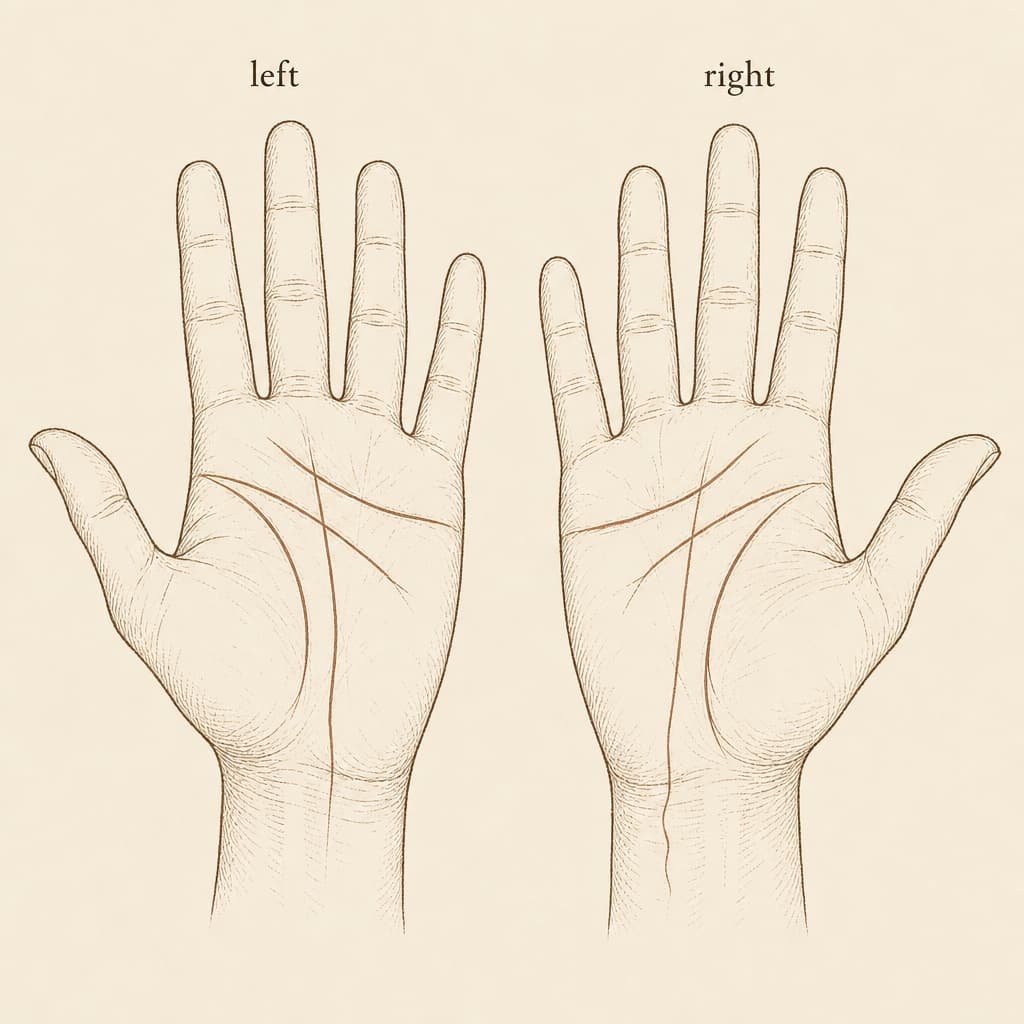
Read both. Your dominant hand (the one you write with) shows who you have become through your choices, experiences, and work. Your non-dominant hand shows what you were born with — your inherited temperament, the personality you would have without active shaping. The differences between the two are themselves the most interesting reading: they tell the story of how much you have changed from your starting conditions.
The traditions disagree mainly on which hand to weight more heavily. The Indian (Vedic) convention reads the right hand for men and the left for women, with the opposite hand showing inherited tendencies. The Western convention (descended from Cheiro) reads the dominant hand regardless of gender. Modern practice has converged on reading both, with the dominant hand carrying primary weight and the non-dominant providing the developmental contrast.
The reason the question matters at all: the lines on your two hands are usually similar but rarely identical. Where they differ — sometimes substantially — you lose meaning by reading only one. A person whose two hands look very different has changed substantially from who they started out being; the direction of that change is itself a reading.
If you'd like to see what each of your hands actually shows — and whether they differ meaningfully — the app reads both from photos and tells you what changed.
The Indian (Vedic) tradition
In Vedic palmistry, the convention is right hand for men, left hand for women. The "primary" hand (right for men, left for women) is read for the developed self — what the person has done with what they were given, who they have become. The "secondary" hand (left for men, right for women) is read for inherited tendencies — what was given by birth, lineage, family.
This convention has practical roots in the older Indian framework where right and left were associated with masculine and feminine principles independent of which hand the person actually wrote with. The system worked when it was applied consistently — the reader knew which hand to give weight to in any reading.
Modern Indian palmists have largely moved away from the strict gender split, partly because handedness doesn't actually correlate with gender, partly because the underlying principle (one hand for the inherited self, one for the developed self) works better when applied via dominance than via gender. Most working palmists in India today use the dominant hand for the developed-self reading regardless of gender, while still acknowledging the older convention when working with traditional clients who expect it.
The Western (Cheiro) tradition
Western palmistry as systematised by Cheiro (the pen name of the nineteenth-century Anglo-Irish palmist Louis Hamon) treats the dominant hand as the primary reading hand for both men and women. The non-dominant hand is read either as showing inherited tendencies (similar to the Indian secondary-hand reading) or as showing what the person could have been if circumstances had been different — the road not taken.
The Western convention is simpler and easier to teach, which is part of why it became standard in English-language palmistry guides. It also avoids the gender-essentialism of the older Indian convention, which has been a barrier to those traditions for many modern readers.
Within the Western tradition there is a minor disagreement about how much weight to give the non-dominant hand. Cheiro himself read it as a useful supplementary reading — informative but secondary. Later palmists, particularly in the twentieth-century American tradition, sometimes treated the two hands as equally important and read them comparatively.
The modern resolution: read both
Most working palmists today read both hands and treat the comparison as the most informative reading available. The basic interpretation:
The non-dominant hand shows your inheritance — what you were born with, in terms of temperament, family conditioning, and natural inclinations. It is the personality you would have if you had not actively shaped yourself.
The dominant hand shows your developed self — who you have become through your choices, experiences, education, work, and relationships. This is the present-day you.
The differences between the two hands tell the story of your development. A person whose dominant and non-dominant hands look very similar has not significantly changed from who they started out being — for better or worse, they are living out their inherited temperament. A person whose two hands differ substantially has changed considerably from their starting conditions; the direction of change (the dominant hand showing stronger lines, deeper definition, or more lines than the non-dominant) tells you what direction the change went.
For most readings, the practical sequence is: glance at both hands, identify any major differences, then focus the detailed reading on the dominant hand. Where the two differ, mention the difference — that's often where the most interesting reading is.
A few common situations
What if I am ambidextrous? Read whichever hand you write with primarily, or whichever hand feels more "yours" — there is usually one even for ambidextrous people. If neither hand clearly dominates, treat both as primary and read them as a single complex picture.
What if my non-dominant hand looks much stronger than my dominant? This is uncommon and read as a person with substantial inherited capacity that they have not fully developed — significant raw potential, sometimes hampered by circumstance, sometimes by lack of access to the conditions that would have allowed it to express. Often present in palms of people from constrained early-life environments who have not yet had the chance to develop into who they could be.
What if my dominant hand looks much stronger than my non-dominant? The opposite reading: a person who has substantially exceeded their starting conditions. Often present in first-generation professionals, in people who emigrated from constrained environments, in people who were the first in their family to pursue particular work.
Common questions
Should I read my left hand or my right hand?
The modern standard is: read both. Use the dominant hand (the one you write with) for the primary reading — that's who you are now. Use the non-dominant hand to see what you were born with and how much you have changed. The differences between them are themselves meaningful. If you can only read one hand, read the dominant hand.
I heard that women should read their left hand and men should read their right. Is that true?
That is the older Indian (Vedic) convention. It works internally — readers who follow it consistently get coherent readings — but it does not match how most modern palmists work, including most Indian palmists today. The dominant-hand convention (which doesn't depend on gender) has become standard because handedness is what actually correlates with developed-self vs inherited-self in the lines, not gender.
What if my two hands look very different?
That difference is one of the most interesting readings the two hands can give. It indicates that you have changed substantially from who you started out being. The direction of change matters: a dominant hand with stronger, cleaner, more developed lines than the non-dominant indicates positive growth — you have built on what you were given. A dominant hand that looks weaker or more fragmented than the non-dominant is rarer and indicates a person whose life circumstances have made it difficult to express what they were born with.
Do both hands change over time, or just the dominant one?
Both hands change, but the dominant hand changes more. The dominant hand records the active development of the person — the choices they make, the experiences they have, the work they do — and so it shows more change across time. The non-dominant hand is more stable; it tends to retain the patterns of the inherited self even as the dominant hand evolves. The widening or narrowing of the gap between the two hands across years is itself something palmists pay attention to.
I am ambidextrous. Which hand should I read?
If you genuinely have no dominant hand, treat both as primary and read them as a single complex picture — the differences between them still tell a story, just one of dual development rather than developed-vs-inherited. In practice most ambidextrous people have a slightly preferred hand for fine motor tasks (writing, drawing); read that one as the dominant for palmistry purposes if you have to choose just one.
Related reading
- How to Read Your Palm— The complete beginner's guide — which hand to read, which lines matter, and the order to read them in.
- Heart Line— How you love, how you trust, and what your relational style says about you.
- Life Line— Vitality, energy, and the rhythm of how you move through change — not, contrary to myth, lifespan.
- Mounts of the Palm— Venus, Jupiter, Saturn, Apollo, Mercury, Mars, Luna — the raised areas that frame how every line is read.