Palmistry
The Money Line: What Your Palm Says About Wealth
Despite the name, palmistry doesn't have a single "money line" — it has a small set of lines and signs that, read together, suggest how wealth tends to come to you and how you tend to handle it.
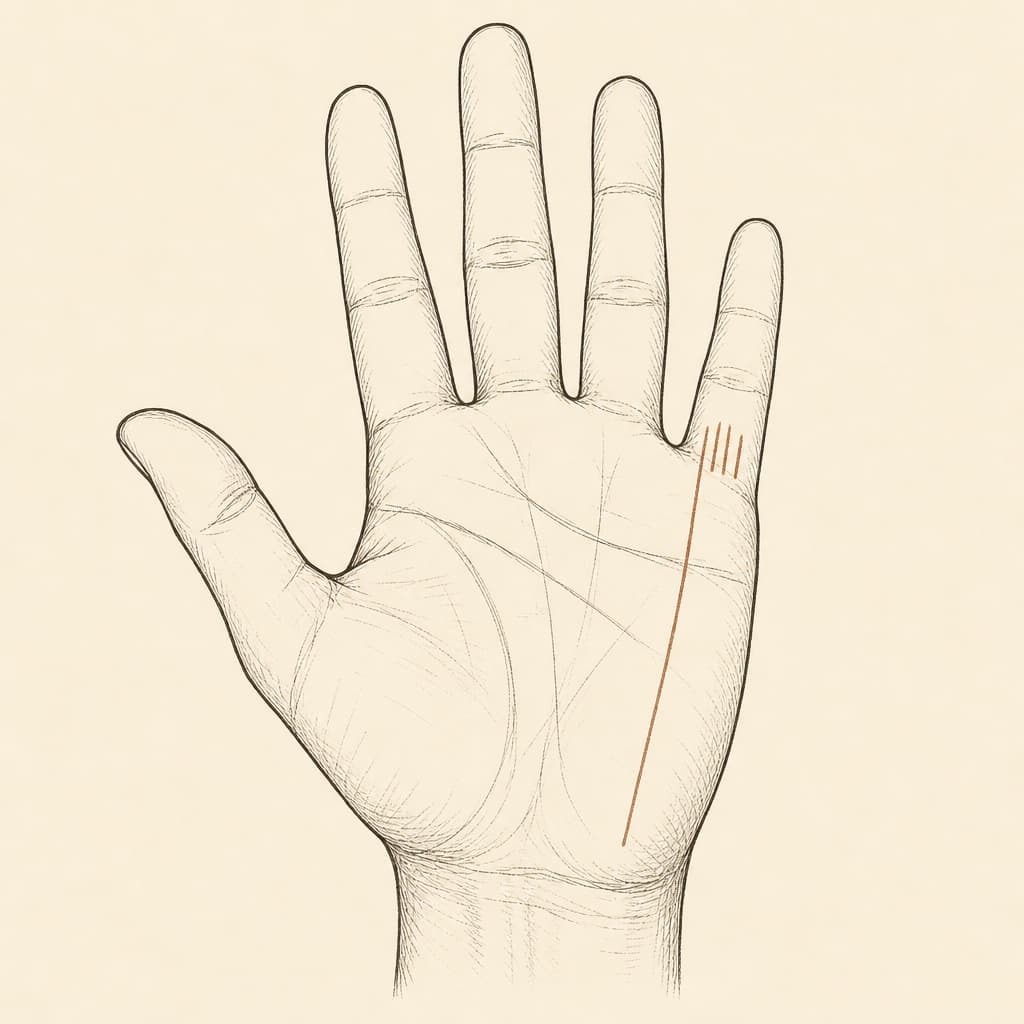
Your palm has no single "money line" — despite what most modern guides suggest. What it does have is a small set of lines and signs that, read together, tell you something about your relationship with wealth: the Mercury line under your little finger (sometimes called the line of business), the sun line under your ring finger, the fate line, and a triangular shape in the centre of your palm called the money triangle in Indian palmistry.
What these signs read for is your financial style — whether wealth tends to come through structured employment or entrepreneurial work, whether money comes to you through effort or through inheritance and gift, whether you handle it instinctively or have to think about it carefully, and whether your financial life is likely to be steady or to come in waves. Useful readings, all of them. Specific monetary amounts are not what palmistry pretends to predict.
The money signs also shift across a life more than the major lines do. A palm read at twenty often shows fewer financial markings than the same palm at forty, when actual financial life has had time to leave its mark.
If you'd like to see what the money-related signs on your own palm actually say, the app reads them from a photo and walks you through what it finds.
The Mercury line: the closest thing to a true money line
The line that modern guides most often call the money line is the Mercury line: a vertical line running up the palm toward the base of the little finger. The little finger's base is the Mount of Mercury, associated in palmistry with commerce, communication, quick intelligence, and dealings with money.
A clear, deep Mercury line is read as a person with strong financial intuition — they understand the flow of money, they negotiate well, they are alert to opportunities others miss. They are often drawn to commerce, to entrepreneurship, or to professions where financial reasoning is central (finance, sales, business strategy). A faint or absent Mercury line is not the absence of financial competence — it is the absence of money as an organising preoccupation. Many people with no Mercury line are perfectly capable with money but do not orient their lives around it.
The Mercury line is one of the lines most likely to develop later in life. It often appears or deepens when a person becomes financially independent, starts a business, or takes on serious money-related responsibility. Its absence in a young palm is not predictive; its development across a life often parallels the person's actual financial trajectory.
The sun line and wealth through recognition
The sun line — covered in detail on its own page — is the vertical line running toward the ring finger. While its primary reading is recognition and reputation, it has a secondary association with wealth that comes from being publicly valued. A strong sun line alongside a strong Mercury line is read as the person who builds wealth through reputation: their work is publicly recognised, and that recognition translates into income.
A strong Mercury line without a sun line is read as the trader's configuration: someone who makes money through skill at exchange and timing, without needing public visibility. A strong sun line without a Mercury line is read as someone whose recognition does not always convert to wealth — common in many artistic and academic fields where reputation outpaces income.
The "M shape" and what it actually means
A persistent piece of internet folklore claims that having an "M shape" formed by the heart, head, life, and fate lines on your palm indicates great wealth. The M-shape claim is folk-modern rather than classical — neither Vedic nor Cheiro-tradition palmistry treats it as a wealth indicator.
What classical palmistry does say about the configuration: a palm with all four major lines clearly defined — heart, head, life, and fate — is read as a person whose major life systems are all in working order. They are emotionally engaged (heart), they think clearly (head), they have physical vitality (life), and they have a sense of direction (fate). This is a strong palm regardless of the visual shape it creates. Whether it forms an "M" depends on the angles of those lines on a particular hand, and the M itself is incidental.
The reason the M-shape claim took off is that it is a satisfying-feeling pattern. Palmists in person rarely make it the centerpiece of a reading because it is not how the lines are actually read. If you have a clean four-major-line palm, you have a strong palm — but the strength is in the lines being well-formed, not in their happening to look like a letter.
Other signs read for wealth
Several smaller signs are traditionally read alongside the lines for financial questions.
The triangle of money, or money triangle, is a triangular shape formed where the head line, life line, and fate line cross each other near the centre of the palm. A clearly-defined, closed triangle in this position is read in Indian palmistry as a sign of accumulated wealth — the person tends to retain what they earn rather than spend it through. A broken or open triangle is read as wealth that comes in but does not stay.
Vertical lines on the Mount of Mercury (under the little finger) are sometimes counted as small money-related signs even when they don't form a single clear Mercury line. Many short vertical marks on this mount are read as multiple income streams or business interests — common in entrepreneurial palms.
A fate line that is unusually strong and travels all the way to the Mount of Saturn is read as a person whose career produces sustained income — not necessarily great wealth, but reliable, sufficient, steady. A weak or fragmented fate line is read as more variable income, common in freelance and creative careers.
Money-related variations
Strong Mercury line (the trader's line)
A clear, deep vertical line running up the palm toward the little finger is the strong Mercury line. Read as instinctive financial intelligence, comfort with negotiation, and the kind of person who reads markets well. Often present in entrepreneurs, traders, and people whose work involves the flow of money.
Money triangle
A triangle formed in the centre of the palm by the intersection of the head line, life line, and fate line is read in Indian palmistry as a sign of accumulated wealth. The triangle being clearly closed is the positive form; an open or broken triangle is read as wealth that arrives but does not stay.
Vertical lines on the Mount of Mercury
Short vertical lines on the area below the little finger — even when they don't form a single Mercury line — are read as small money-related signs. Several of them together is sometimes read as multiple income streams: a person whose financial life draws from several sources rather than one.
Long, deep fate line
A strong fate line travelling the full length of the palm is read as a sign of sustained income from steady work — not necessarily wealth in the dramatic sense, but reliable financial life from a stable career.
Combined sun line and Mercury line
When both the sun line and a Mercury line are well-defined, the reading is wealth that comes through recognition: the person's work is publicly valued, and the value translates into income. This combination is one of the most positive financial readings in classical palmistry and is common in palms of well-known professionals — established artists, recognised consultants, public-facing entrepreneurs.
No money lines at all
A palm with no Mercury line, no money triangle, and no significant Mount of Mercury markings is read not as financial failure but as a life not centrally organised around money. Many people with this configuration are entirely competent with finances but do not think about money as a primary subject — academics, public servants, religious practitioners, and people whose primary motivation is not material accumulation.
Star or cross on the Mount of Mercury
A small star or cross-shape on the area below the little finger is read in classical palmistry as a particularly positive sign for sudden financial gain — windfalls, successful speculative ventures, unexpected inheritances. Modern palmists treat this cautiously; sudden-gain predictions have a poor track record. The sign is more reliably read as a moment in life where finances changed significantly through unexpected means.
Common questions
Where exactly is the money line on the palm?
There is no single money line in classical palmistry. The line most often called the money line in modern guides is the Mercury line — a vertical line running up the palm toward the base of the little finger. Money-related reading also draws on the sun line (under the ring finger), the fate line, and certain configurations like the money triangle in the centre of the palm.
Does the M shape on my palm mean I will be rich?
No. The M-shape claim is folk-modern internet content rather than classical palmistry. Neither Indian nor Western palmistry treats the visual M as a wealth indicator. What it does indicate — when it appears clearly — is that all four major lines (heart, head, life, fate) are well-defined, which is read as a person whose major life systems are in working order. That is a strong palm, but the strength is in the lines being clear, not in their happening to form an M.
What is the money triangle?
The money triangle is a triangular shape formed in the centre of the palm where the head line, life line, and fate line intersect. A clearly-formed, closed triangle in this position is read in Indian palmistry as a sign of accumulated wealth — the person tends to retain what they earn. An open or broken triangle is read as wealth that arrives but does not stay.
I have many small lines under my little finger. What does that mean?
Multiple short vertical lines on the Mount of Mercury (under the little finger) are read in classical palmistry as multiple money-related interests or income streams. Common in palms of entrepreneurs, freelancers, and people whose financial life draws from several sources. The deepest of these lines is sometimes read as the primary income source; the smaller lines as secondary or developing streams.
Can the money lines on my palm change?
Yes. The Mercury line and other money-related signs are among the lines most likely to develop and shift across a life. New lines appear as new income sources develop; existing lines deepen as financial life becomes more substantial; signs fade if a person's financial life simplifies. A palm read at twenty often shows few money signs; the same palm at forty often shows many more.
Related reading
- Fate Line— Career trajectory, sense of direction, and external forces shaping your path.
- Sun Line (Apollo Line)— Recognition, reputation, and the part of life where your light shows publicly.
- Mounts of the Palm— Venus, Jupiter, Saturn, Apollo, Mercury, Mars, Luna — the raised areas that frame how every line is read.
- How to Read Your Palm— The complete beginner's guide — which hand to read, which lines matter, and the order to read them in.