Palmistry
The Travel Line: Movement and Migration
Short horizontal lines on the percussion edge of the palm, below the marriage line area. They map the journeys — physical and circumstantial — that shape your life.
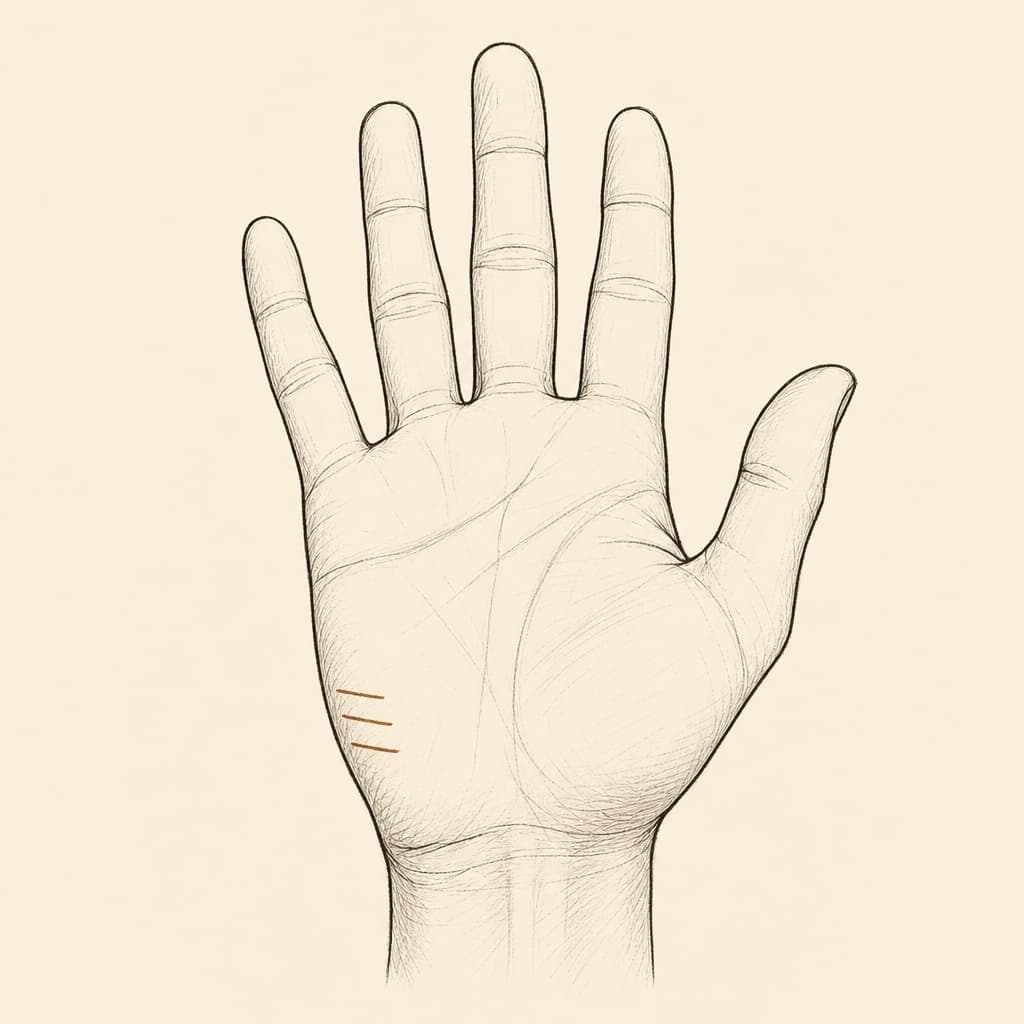
Your travel lines are the short horizontal marks on the percussion edge of your palm, low down — between the heart line and the wrist, on the side opposite the thumb. They map the journeys that genuinely shape a life: not every weekend trip, but the migrations, the long sabbaticals, the moves abroad, and the pilgrimages that change something fundamental about who you are.
The region they sit in is called the Mount of Luna in classical palmistry, associated with imagination and the unfamiliar. Indian palmistry reads travel lines closely — partly because so much of the modern Indian story is a story of migration, internal and international, and the lines on this region tend to register that history.
They also read for the broader category of movement, not just physical travel. A person who never leaves their hometown but reinvents themselves through a major decision can show clear travel lines. A person who travels constantly for work without any of it changing them may show only faint marks here.
If you'd like to know whether your palm shows significant travel ahead — or already behind — the app reads it from a photo.
Where the travel line is
Look at the percussion edge of your dominant hand — the side opposite the thumb. Above this edge sits the marriage line area (just below the little finger). Below the marriage line area, between the heart line and the wrist, is the Mount of Luna. The travel lines sit in this lower area: short horizontal marks running inward from the percussion edge.
Some palms show one or two clear travel lines. Some show many. Some show only the faintest marks. The clearer and deeper the line, the more significant the journey it records.
What the line is read for
Three readings: the journey itself, the change it brings, and the timing.
The journey itself is the surface reading. A clearly-defined travel line indicates a significant trip — usually a journey of physical distance, often international, sometimes a relocation. The depth of the line indicates how significant the journey was: a deep line records a journey that genuinely shifted the person's trajectory; a faint line records a journey of meaning but smaller consequence.
The change the journey brings is what palmistry actually cares about more than the trip itself. A travel line that ends in a fork or branches into other lines is read as a journey that opened multiple new paths — a migration that led to a new career, a new relationship, a new self-understanding. A travel line that crosses or connects to the fate line is read as travel that significantly reshaped the person's direction.
Timing is approximate. Travel lines lower on the Mount of Luna (closer to the wrist) are read as earlier-life journeys; travel lines higher (closer to the heart line) are read as later-life journeys. The reading is rough; classical palmistry does not pretend the timing is precise.
Travel line variations
One clear travel line
A single deep horizontal line on the Mount of Luna is read as one significant journey in the person's life — usually a migration, an extended period abroad, or a defining trip that changed something fundamental. The depth indicates how much it changed; the position indicates roughly when.
Multiple travel lines
Several clearly-defined travel lines are read as a life shaped by multiple journeys — common in people who have lived in several countries, in expatriates, in long-haul international workers, and in people whose family or career has involved repeated relocation. Modern palmists often see this configuration in the palms of professionals whose work is genuinely global.
Travel line connecting to the fate line
A travel line that touches or crosses the fate line is read as a journey that significantly reshaped the person's direction or career. A migration that led to a new profession, a sabbatical that reset the path, an international move that became formative. One of the most positive travel-line configurations.
Travel line ending in a fork or branch
A travel line that splits at its inner end is read as a journey that opened multiple paths — a single trip that produced more than one significant outcome. Often associated with migrations that led both to a new career and to a new long-term relationship, or to a sabbatical that produced both a creative project and a major life decision.
Travel line crossed by a vertical line
A short vertical line crossing a travel line is read in classical palmistry as obstacles or difficulties encountered during a significant journey — visa problems, illness abroad, family tensions caused by distance. The depth of the crossing line indicates the severity.
No visible travel lines
A palm with no visible travel lines is read as a life not significantly shaped by physical journeys. Many people who live productive, contented lives close to where they were born have no travel lines. The absence is not negative; it indicates a person whose trajectory is shaped by other forces.
Common questions
Does the travel line predict if I will move abroad?
It can suggest a tendency toward significant travel — usually long-distance and life-changing — but classical palmistry does not pretend to predict specific destinations or dates. A clear travel line indicates that journeys are likely to be a meaningful part of your life, particularly in the rough period the line's position suggests. Whether that takes the form of moving abroad, repeated long-distance work, or extended sabbaticals depends on factors palmistry doesn't pretend to read.
What's the difference between the travel line and other lines on the percussion edge?
The percussion edge has two main horizontal-line zones. The upper zone, just below the little finger, holds the marriage lines. The lower zone, between the heart line and the wrist (on the Mount of Luna), holds the travel lines. They are read separately: marriage lines are about significant partnerships; travel lines are about significant journeys. They occasionally interact — a travel line that touches a marriage line is sometimes read as travel within or because of a partnership.
I travel constantly for work but have no travel lines. Why?
Travel lines record journeys that change the person, not journeys per se. Frequent business travel that does not significantly reshape your life — repeated work trips to familiar destinations — typically does not register on the palm. The line records the journey that changed something: the migration, the sabbatical, the trip that became formative. If your travel is high-volume but logistically familiar, the absence of travel lines is consistent.
Can travel lines develop later in life?
Yes — especially after significant journeys. Many palms show no travel lines in early adulthood and develop clear ones after a migration, an extended period abroad, or a transformative trip. Like several other minor lines (Mercury, sun), travel lines record actual life events as they accumulate.
Related reading
- Marriage Line— In Indian palmistry: long-term partnership, emotional unions, and significant relationships.
- Fate Line— Career trajectory, sense of direction, and external forces shaping your path.
- Mounts of the Palm— Venus, Jupiter, Saturn, Apollo, Mercury, Mars, Luna — the raised areas that frame how every line is read.
- How to Read Your Palm— The complete beginner's guide — which hand to read, which lines matter, and the order to read them in.